
Lending
Small Towns
Farm and Food
Policy
In this edition:
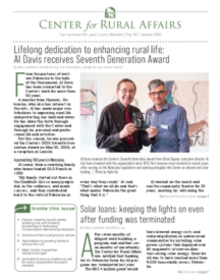
- Lifelong dedication to enhancing rural life: Al Davis receives Seventh Generation Award – A rancher from Hyannis, Nebraska, who also has interest in the arts, Al has made major contributions to improving rural life and protecting our land and water. He has done this both through engagement with the Center and through his personal and professional life and activities.
- Solar loans: keeping the lights on even after funding was terminated – The $62.4 million grant would have lowered energy costs and reduced pollution in underserved communities by installing solar power systems that deployed over 60 megawatts of new residential-serving solar energy. Solar for All was to have reached more than 9,000 households across Nebraska.
- Farmer chasing record yields, building soil, and sharing knowledge in Nebraska Conservation Mentorship Network – For Greg Keller, the decision to adopt conservation practices on his 1,000-acre farm near Monroe, Nebraska, in central Nebraska, was born out of a pragmatic struggle against erosion. Faced with persistent loss of soil in the hills of Platte County, where heavy rains frequently washed out hilltops into ditches and forced costly replanting, Greg realized that conventional views of soil management were no longer protecting his bottom line.
- 5 lessons from rural grocery stores – Rural grocery store owners do far more than stocking shelves. Running a grocery in a small town is more complex, and more essential, than it often appears. When a rural grocery store struggles, the impact affects the entire community.
- Agrivoltaics is growing interest across the U.S. – Across the country, farmers, landowners, and rural communities are taking a closer look at how solar development can work alongside agriculture instead of competing with it. Agrivoltaics, or dual-use solar, is growing interest as people look for ways to keep land productive, support conservation, and create new opportunities.
- Meet Center supporter: Adriana Dungan – A native of Mexico, Adriana Dungan has worked with the Center as a business development consultant, and previously as the Center for Rural Affairs’ Hispanic Business Center director from 2004 to 2010.
- Lexington’s loss is a wake-up call for more competitive livestock markets – Nebraska’s economy will suffer the loss of $3.28 billion annually due to direct and multiplier effects related to the Lexington plant closure, according to a Dec. 22 analysis by the University of Nebraska Department of Agricultural Economics.
Would you like to receive our paper or virtual newsletter? Sign up here.