
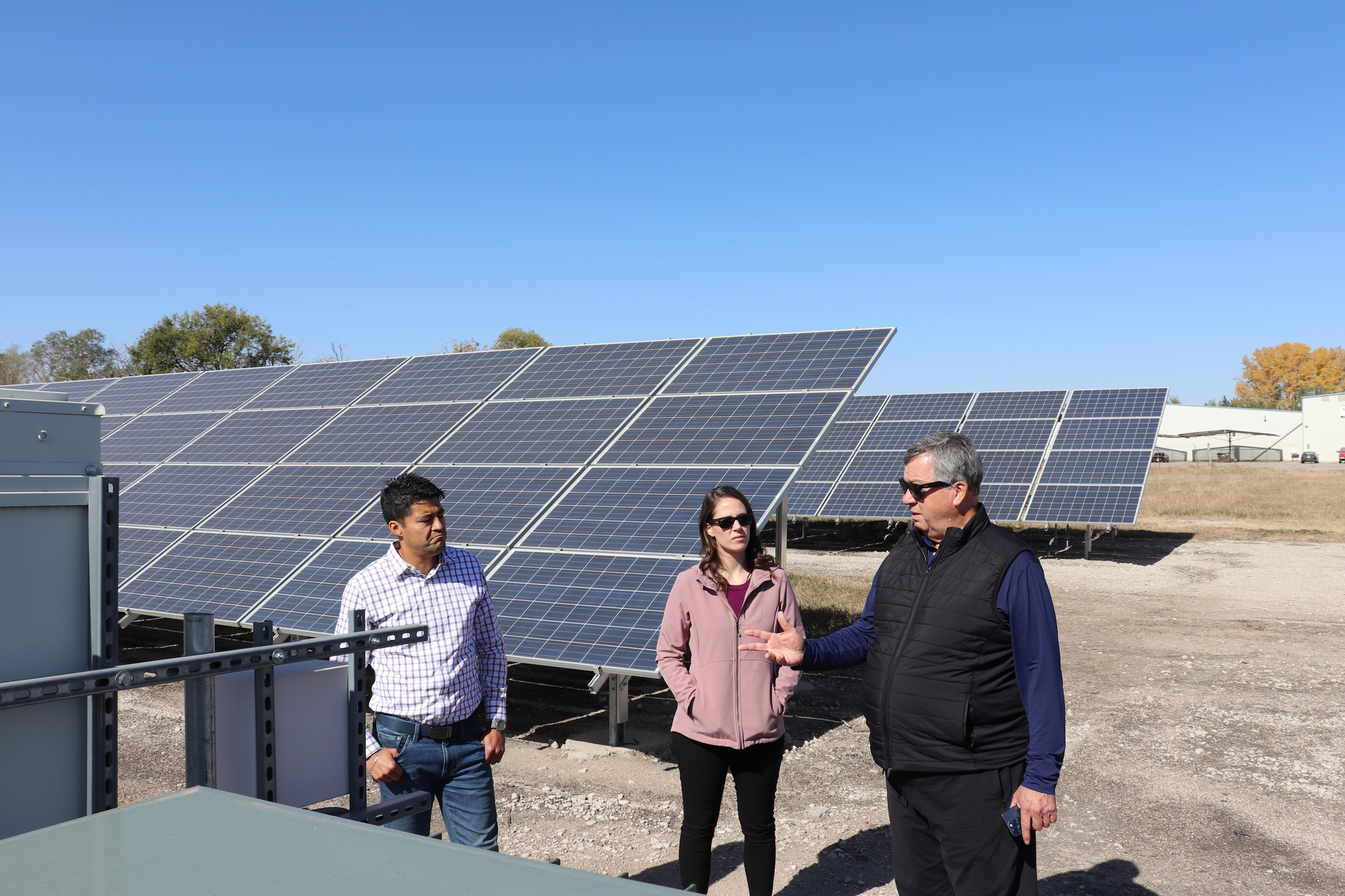
After seven months of diligent work building a program and another seven months of uncertainty, the Center for Rural Affairs was notified that funding for its Nebraska Solar for All program was terminated last year. The formal notice was issued by the Environmental Protection Agency (EPA) on Aug. 7, 2025.
The $62.4 million grant would have lowered energy costs and reduced pollution in underserved communities by installing solar power systems that deployed over 60 megawatts of new residential-serving solar energy. Solar for All was to have reached more than 9,000 households across Nebraska.
“The Solar for All grant was particularly exciting because it represented a historic shift in how clean energy is deployed,” said Daniel Padilla, the Center’s Director of Climate Lending.
This opportunity would have allowed the Center and its partners to increase the amount of solar energy available in the state by more than 60% over the five-year grant period and transform the residential solar market.
“Solar for All was not just about going green. Solar for All would have been community-led and residential focused,” said Daniel. “The program would have funded fundamental infrastructure and was designed to lower the energy burden for families who spend a disproportionate amount of their income on utilities.”
Rooted in community
Starting in July 2023, Center staff began developing its Nebraska Solar for All proposal. They consulted with more than 50 stakeholders including public utilities, state agencies, municipalities, Tribes, housing developers, housing organizations, solar developers, workforce partners, and community-based organizations. Ultimately, the Center received 27 letters of support from stakeholders for its application, including the state investment finance authority.
The three-part Nebraska Solar for All program application included low-interest loans, grants, and subsidies to support three key components:
- Community solar: Collaborating with public utilities in the state to develop residential-serving community solar arrays, allowing eligible residents to participate through subscriptions or by owning panels.
- Multifamily affordable housing solar: Partnering with utilities, housing developers, and low-income housing financing partners to deploy solar for income-qualified multifamily housing units.
- Rooftop solar: Providing behind-the-meter or rooftop solar for qualified households, screening residents for eligibility and site suitability, and connecting them to technical service providers and solar installers.
In addition, the program was to provide resources to help train workers to install and maintain the new installations.
The grant would have allowed the Center to focus on ensuring that low-income and historically disadvantaged households have equitable access to solar power and the means to become owners of solar energy production.
Getting down to work
In May 2024, the EPA announced the Center was a recipient of a $62.4 million grant under the Solar for All program, and on July 12, 2024, the Center was formally awarded the grant. The majority of the award was to be used to establish a revolving fund, money that would be replenished, in part, by interest paid on loans and would continue to be available to fund solar development even after the expiration of the five-year grant.
As part of the Greenhouse Gas Reduction Fund established by the Inflation Reduction Act, the Center received one of 60 grants nationwide—totaling $7 billion—awarded to states, territories, Tribal governments, municipalities, and nonprofits to facilitate community participation in residential solar energy.
Within a month, the Center had assigned four staff to work on Solar for All and issued a contract for support services.
During the year to follow, the Center worked diligently to implement the grant in Nebraska and to meet EPA’s requirements. The initial timeline expected the EPA contract in place by September 2024, followed by a one-year planning period, then the launch of financial products.
Will they, won’t they… they won’t
In early 2025, actions by the new administration in Washington were creating far-reaching consequences for rural people and rural places. Within days of taking office in January, the administration froze the EPA’s Solar for All awards. Then, after four more weeks, the Solar for All award was released by the EPA.
On Aug. 7, 2025, the Center received a letter of termination from the EPA regarding its Solar for All grant. This action meant that Center staff were forced to suspend work on all projects, creating tremendous uncertainty for all stakeholders.
By the time of termination, the Center was in advanced discussions with multiple communities and housing developers around the state to deploy more than $20 million in grant funding for solar projects, with additional projects in earlier stages.
“While the termination of the Solar for All grant is a setback, it doesn't change the fundamental need for families,” Daniel said. “It is not just a sustainable and 'green choice;' [solar] is also a hedge against inflation.”
While Congress holds the authority over federal appropriations, congressional response has been limited. In the face of actions by the administration and lack of action by Congress, the courts have stepped in in some cases and ordered restoration of funding. Court action is limited and has not addressed the full scope of the challenge.
The Center filed a dispute of termination with the EPA in late August and a petition for reconsideration to the EPA in November. Although those efforts were denied by the EPA, the Center continues to believe the termination was improper and is evaluating its legal options.
Sun’s not going down
Despite the challenges posed by the termination and the negative impact on both the Center and communities that Congress intended to benefit from the Solar for All program, the Center’s important work supporting solar development in Nebraska continues. In designing the new area of solar lending at the Center, leadership carefully built a multi-faceted approach, searching for different sources of funding. This allowed the organization to continue some solar lending without the Solar for All grant.
“It was an easy decision. The work must keep going,” Daniel said. “While we always wanted to revolve as much of our grant monies as possible, our financial realities have changed. But, our goal of making our communities resilient does not change.”
Fortunately, Center leadership had already identified, applied for, and was awarded a second source of funding for solar lending which allows the organization to continue its solar lending work.
The Center was awarded a $10 million loan from the Coalition for Green Capital under the National Clean Investment Fund program. The Center is turning around these funds and seeking to make an initial $10 million in loans to support solar projects up to 10 MW in size.
Solar lending doesn’t stop
The Center now offers community and business solar loans as well as personal loans. Community and business solar loans are for construction, to enable investment tax credit safe harboring, and for working capital for qualified solar businesses. These loans are for $100,000 to $3 million and are targeted to serve local businesses, schools, and municipal buildings.
“By providing essential construction and working capital, we want to empower local contractors and entrepreneurs to own and build these systems themselves, cultivating a Nebraska [solar] workforce,” said Daniel.
Personal loans are for construction loans for solar arrays up to 99 kW in size for projects located in Nebraska, with limited ability to consider well-qualified projects elsewhere. Personal loans will be awarded in an amount between $5,000 to $250,000.
Alongside the loans, Center staff is providing pre-development and feasibility support by conducting site assessments and system sizing, while coordinating with local utilities to ensure a successful grid connection.
Turning toward the future
“I think of the Center's work and our loan products as a critical backstop to ensure rural and Tribal communities in Nebraska are not left behind,” Daniel said. “We need to ensure low-to-moderate income households and small rural businesses are not priced out of the energy transition.”
Across the country, solar energy is needed for both reliability and load growth.
For example, in Nebraska, today data centers account for almost 25% of generation, while in 2018, it was 1%. By 2035, data centers are projected to account for 41% of generation.
“I think utilities are being pragmatic about solar,” Daniel said. “With electric utilities implementing rate hikes, solar is a proven solution and a hedge against rising electric rates. This is making smaller cities and villages consider small community solar projects while making residential solar more attractive.”
This aligns with the Center’s mission of cultivating strong communities rooted in social and economic justice, environmental stewardship, and opportunity for all.
“The Center wants to be part of this transformation by helping our cities and families generate their own power and lock in energy savings for decades, making the communities we live in more resilient,” Daniel said.
To learn more about solar lending at the Center, visit cfra.org/SolarLoans.