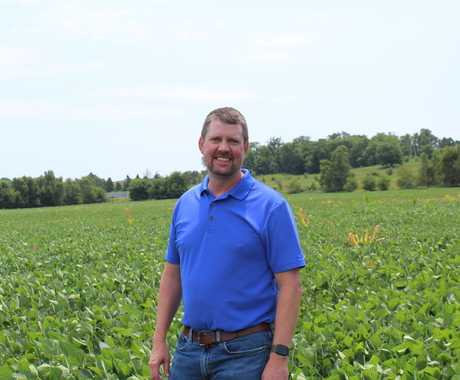

For Greg Keller, the decision to adopt conservation practices on his 1,000-acre farm near Monroe, Nebraska, in central Nebraska, was born out of a pragmatic struggle against erosion.
Faced with persistent loss of soil in the hills of Platte County, where heavy rains frequently washed out hilltops into ditches and forced costly replanting, Greg realized that conventional views of soil management were no longer protecting his bottom line.
So, 26 years ago, he began practicing no-till to reduce disruptions to the soil profile and increase soil aggregate formation. Fifteen years later, cover crops were introduced as another line of defense—keeping living roots in the system year round for the last 11 years.
What began as a solution to keep precious soil out of the ditches has since evolved into a multi-pronged regenerative system that produces 300+ bushels/acre corn yields. Greg’s deep commitment to putting soil biology first has made a big impact on the land as well as the economics of his operation.
Greg’s success is a testament to the power of shared knowledge, a core value he promotes in his role as a mentor in the Conservation Mentorship Network. As one of 28 experienced farmers and ranchers across Nebraska serving in this role, Greg helps other producers navigate the complexities of regenerative farming.
The Nebraska Conservation Mentorship Network is a no-cost, producer-led initiative designed to meet farmers wherever they are in their journey that offers a flexible "come as you are" approach. Whether a producer is just starting to consider cover crops or is looking to fine-tune a complex multi-practice system, the network provides the one-on-one mentorship, farm tours, and small-group discussions needed to succeed. By joining, Nebraska producers gain access to a community of like-minded peers and a platform to exchange ideas, ensuring that no producer has to innovate in isolation.
At the heart of Greg’s own innovation is a custom-engineered twin-row rye system, a cover crop technique he developed after observing the limitations of standard planting methods. Dissatisfied with the yield hits he witnessed when planting corn into solid-seeded rye, Greg modified his equipment to plant rye in 7.5-inch twin rows. This creates dedicated strips of cover crop that act as protective barriers for the soil.
By utilizing GPS, Greg precisely slides his planting line to place seed directly in the gap between these rye rows. This precision setup allows him to reap the soil building and weed suppression benefits of the cover crop while ensuring the corn does not have to compete for vital nutrients and moisture. Greg estimates a yield bump of 10 to 25 bushels/acre for his irrigated corn planted after rye, which tends to vary depending on when the rye is terminated.
Greg’s soil biology has reached a point where natural processes now allow him to reduce many inputs and forgo others entirely. Greg estimates his fields are home to over 1 million earthworms per acre—a level of macrobiological activity that generates an estimated 100 to 150 tons per acre of nutrient-rich worm castings annually. This influx of natural fertilizer has allowed him to completely eliminate micronutrient inputs, a group of essential plant nutrients historically naturally present in soils that are now often added via soil amendment. This has saved Greg an estimated $70 to $100 per acre in 2026 with the high price of these inputs.
Greg’s pursuit of efficiency also led him to transition to 100% GMO-free corn. By opting for hybrid corn, he has slashed his per-bag seed costs and eliminated the second pass of glyphosate from his spray program, reducing his farm's chemical footprint while bolstering his bottom line.
Programs like the Conservation Mentorship Network are vital for highlighting the work of farmers like Greg and making their hard-earned, practical knowledge accessible to others. Participation as a mentor in the network is compensated and designed to fit into a busy producer's schedule. The network offers multiple outlets for learning including an online exchange group, webinars, and in-person field days.
For other producers considering a move toward conservation agriculture, Greg’s advice is rooted in patient practice of the fundamentals; he suggests starting small with 40 or 80 acres and committing to the new practice for at least three years to allow the soil biology time to respond. While he acknowledges that the first year is the most challenging, he views the long-term rewards as a "no-brainer" for the next generation of Nebraska farmers.
Greg enjoys hosting other producers on his farm to offer a hands-on look at his custom drills and planters, as well as a chance to discuss the real-world application of regenerative techniques. For any Nebraska farmer or rancher interested in implementing new practices, the Conservation Mentorship Network offers the ability to learn from experienced producers like Greg, engage in community conversations, and get the expert guidance needed to improve your operation.
The goal of the Nebraska Conservation Mentorship Network is to facilitate peer-to-peer relationships among farmers and ranchers across the state that foster learning and advance the adoption of conservation practices.
If you’d like to join the network or request more information, contact Andrew Tonnies at 402.590.7096 or [email protected].