

We aren't afraid of the weeds. The people living in rural America deserve a serious and in-depth look at the issues and forces impacting their communities.
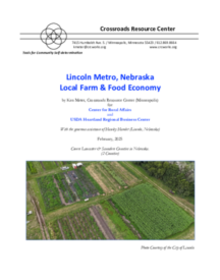
Lincoln, the capital city of a major farm state, spends $1.1 billion each year purchasing food that is sourced outside of the Lincoln Metro region. That is the conclusion of a new study just released by the Center for Rural Affairs (CFRA) and the USDA Heartland Regional Food Business Center. The City of Lincoln's Mayor's Community Committee on Local Food plans to reference the study’s findings to inform future education efforts, as well as local food strategies and initiatives.
- Farm and Food

Check out the latest edition of our Small Business News packed full of resources for entrepreneurs, those looking to own their own business, and small business managers.
- Lending
Editor's note Board of Directors meetings are inspiring. Each March, June, September, and December, Board members and staff get an opportunity to reflect on and celebrate our work. Two meetings out of the year are held in person, which provides us with unique ways to showcase our work. In March, our...
- Lending
- Small Towns
- Farm and Food
- Policy
Renewable energy has provided several benefits for rural communities and counties across Nebraska. In addition to producing clean, low-cost renewable energy, these projects create new employment opportunities during the construction and operation periods. Additionally, renewable generation has...
- Policy
La industria del transporte comercial por carretera desempeña un papel crucial en la economía de nuestro país, garantizando el transporte eficiente de mercancías a nivel nacional, impulsando las cadenas de suministro y creando numerosos empleos. Contribuye al buen funcionamiento de las empresas y...
- Policy
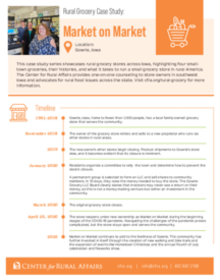
This case study series showcases rural grocery stores across Iowa, highlighting four small-town groceries, their histories, and what it takes to run a small grocery store in rural America. The Center for Rural Affairs provides one-on-one counseling to store owners in southwest Iowa and advocates for...
- Small Towns
- Farm and Food
- Policy

Solar grazing has emerged as a valuable practice with the rising demand for solar energy projects. Using livestock to manage vegetation at solar sites helps maintain the agricultural use of the land, provides new income streams for local farmers, and offers economic and environmental benefits. Solar...
- Farm and Food
- Policy
Nebraskans spend more than $5 billion per year buying food that is sourced from out of the state. The "Nebraska Farm & Food Economy Report" indicates this loss of economic potential is driving a growing interest in locally-produced food.
- Farm and Food
Los habitantes de Nebraska gastan más de $5 mil millones al año en alimentos provenientes de fuera del estado.” El Informe sobre la Economía Agrícola y Alimentaria de Nebraska” indica que esta pérdida de potencial económico está impulsando un creciente interés en los alimentos producidos localmente. El informe ofrece una visión general de la economía agrícola en Nebraska, incluyendo estadísticas sobre el tamaño de las granjas, la producción y las ventas de productos básicos y cómo los residentes gastan su dinero en alimentos.
- Farm and Food

Wind energy was introduced to Iowa in the early 2000s and has been a feature of the state’s landscape since; Howard County saw its first wind turbines erected in 2008 and 2009 with the Pioneer I and II projects. These two projects installed 182 turbines (178 MW) split between the northwest corner of Howard and the northeast corner of Mitchell County around Riceville. In 2019, Madison Gas and Electric built another 33 turbines (66 MW) about 12 miles west of the Howard County seat, Cresco.
- Policy
Energy consumption is on the rise, creating new demand for renewable energy project sites. The U.S. Department of Energy’s Solar Futures study estimates that to fully decarbonize the energy grid, solar will need to make up 40% to 45% of the energy mix, or about 1,600 gigawatts of capacity, by 2050.
- Farm and Food
- Policy
El consumo de energía está en aumento, lo que genera una nueva demanda de proyectos de energía renovable. El estudio Solar Futures del Departamento de Energía de Estados Unidos estima que para descarbonizar por completo la red eléctrica, la energía solar deberá representar entre el 40% y el 45% de la combinación energética, o alrededor de 1,600 gigavatios de capacidad, para 2050.
- Farm and Food
- Policy
Conservation Reserve Program (CRP) landowners with expiring contracts have unique opportunities to continue their legacy of conservation through the CRP-Transition Incentives Program (CRP-TIP). Approximately 155,000 acres of CRP in Iowa and roughly 60,000 acres of CRP in Nebraska are set to expire...
- Farm and Food

Editor's note: Local, state, and national policy directly impact how we live. We always need advocates to speak up for rural America. At the Center, we work to amplify your voices. But, we cannot do it alone. You can: Make your voice heard. Call, email, or write your elected officials. Keep their...
- Lending
- Small Towns
- Farm and Food
- Policy

Consulte la última edición de Small Business News, repleta de recursos para emprendedores, quienes buscan ser dueños de su propio negocio y gerentes de pequeñas empresas.
- Lending

Check out the latest edition of our Small Business News packed full of resources for entrepreneurs, those looking to own their own business, and small business managers.
- Lending
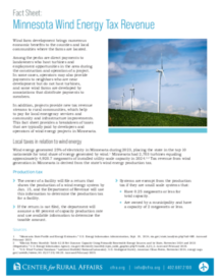
Wind farm development brings numerous economic benefits to the counties and local communities where the farms are located. Among the perks are direct payments to landowners who host turbines and employment opportunities in the area during the construction and operation of a project. In some cases, operators may also provide payments to neighbors who are near development but do not host turbines, and some wind farms are developed by associations that distribute payments to members.
- Policy
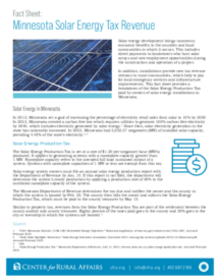
Solar energy development brings numerous economic benefits to the counties and local communities in which it occurs. This includes direct payments to landowners who host solar arrays and new employment opportunities during the construction and operation of a project. In addition, installations provide new tax revenue streams to rural communities, which help to pay for local emergency services and infrastructure improvements. This fact sheet provides a breakdown of the Solar Energy Production Tax paid by owners of solar energy installations in Minnesota.
- Policy

La expansión de la ley de alimentos caseros en Nebraska en 2024 es un paso importante para empoderar a los emprendedores locales y fomentar el crecimiento económico en las comunidades rurales. La ley permite a las personas producir y vender ciertos alimentos de bajo riesgo desde sus hogares sin la necesidad de una cocina comercial. Esto no solo ofrece oportunidades a los productores de alimentos a pequeña escala, sino que también apoya la economía local al mantener el dinero en la comunidad. La ley de alimentos caseros mejorada de Nebraska contribuye a un panorama alimentario más vibrante y diverso en el estado.
- Small Towns
- Farm and Food
- Policy

The 2024 expansion of cottage food law in Nebraska is a significant step toward empowering local entrepreneurs and fostering economic growth in rural communities. The law allows individuals to produce and sell certain low-risk foods from their homes without the need for a commercial kitchen, which not only provides opportunities for small-scale food producers but also supports the local economy by keeping money in the community. Nebraska’s improved cottage food law contributes to a more vibrant and diverse food landscape in the state.
- Small Towns
- Farm and Food
- Policy