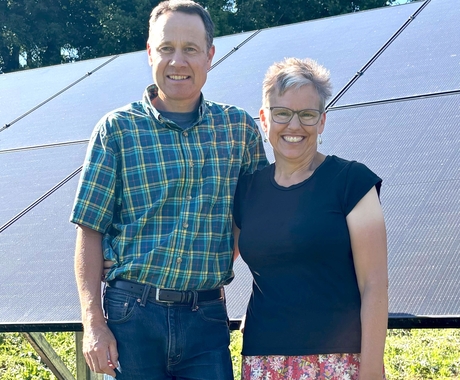

Jan and Cornelia (Neal) Flora, of Ames, Iowa, were honored by the Center for Rural Affairs this spring for their dedication to rural communities across the U.S., namely for their contributions in rural development and sustainable agriculture.
The Floras are the 2024 recipients of the Center’s Seventh Generation Award, a lifetime service award presented to individuals who have made major contributions in improving rural life and protecting our land and water.
Neal and Jan have a shared legacy as rural sociologists whose research addresses alternative strategies of community development and community-based natural resource management in light of changing socio-technical regimes and climate change. One of their publications, “Rural Communities: Legacy and Change,” is now in its fifth edition.
Neal and Jan’s work and research have influenced thousands of students, rural communities, and policymakers. They have each authored hundreds of articles, books, and book chapters that have shaped modern conversations and understanding on diverse rural issues ranging from sustainable agriculture and farmer welfare to community development and social justice to feminism in Latin America and immigration policy.
Note: Sadly, Neal passed away on April 30, a couple of weeks after this interview was conducted. The Seventh Generation Award presentation was held following Neal’s memorial service on May 18 in Ames, Iowa, where numerous family and friends uplifted Jan and family and remembered Neal.
Community Capitals Framework
One of Neal and Jan’s most well-known and influential contributions to rural sociology and sustainable community development is the Community Capitals Framework.
While researching on the ground in towns like Oberlin, Kansas, Jan and Neal found existing economists’ focus on land, labor, and capital lacked the social and cultural aspects they found to be essential in discussions of sustainable community development.
“By expanding it, we included a lot of social variables that we think are pretty darn important,” Jan said. “And, the way of looking at land is very different. Natural capital is different from just looking at land as a commodity.”
They developed a system that went beyond considerations of financial capital and addressed how various systems intertwined.
“We look at natural capital, cultural capital, social capital, physical capital, built capital, and political capital,” Neal said. “Understanding that all communities have these and help people figure out the indicators of theirs and what they need to build on.”
“If you ignore one, you will eventually have problems in your community and probably in your business,” Neal continued. “So we work with communities for them to identify what they’ve got and that also helps them decide where to build.”
That’s where another one of their passions comes in—sustainable agriculture.
“Soil and water are the most endangered,” Neal said. “Sustainable ag we felt was a pretty important part of rural development.”
Center Executive Director Brian Depew commented on the Community Capitals Framework.
“The framework that Jan and Neal developed helped shape the Center’s approach to rural community development,” he said. “Their findings resonated with the Center’s experience and their articulation of the framework helped to drive a common understanding of how and why we go about community change work.”
Rural was meant to be
Now settled in Iowa, Neal and Jan had childhoods thousands of miles apart. Jan grew up in Kansas while Neal grew up in the desert of California on a Navy base. During summers, she worked at a Mammoth Lakes pack outfitter as a cook; while she lived in a desert, snow or forest lands were just a drive away.
“So I was very very interested in rural communities, rural towns,” Neal said.
Jan went to Kansas State as an undergraduate, spending two years there. At the end of those two years, he was convinced to go to Mexico for a summer program with the American Friends Service Committee.
“That just completely changed my views,” he said. “I was a Goldwater Republican before that. It had to do a lot with the other people in the group as well as this complete change in setting from rural Kansas to rural Mexico.”
When he returned to Kansas, he then pursued Latin American studies at the University of Kansas. Jan knew he wanted to go to graduate school, and he was interested in rural areas. His advisor gave him the names of five schools. Cornell University accepted him first, so that’s where he went, starting in 1964.
Meanwhile, Neal attended the University of California, Berkeley, enjoying their one rural sociology class. She decided to enter the field, asking her professor where she should attend graduate school. She didn’t want to be in the Midwest, so she applied to Cornell University.
When Neal arrived, the two met in Ithaca, New York, in the rural sociology department.
The start of careers
Their first jobs out of graduate school took the couple to Kansas State University. Both joined the sociology department, with Neal as the director of the population research laboratory and Jan as an assistant professor.
The situation worked out well when they had their two daughters. Both of their offices were at one end of the hall where former students still remember helping care for their daughters.
“We had one big intro to sociology class that we taught together,” Jan said. “One would swing a daughter in the swing while one was lecturing, then we’d reverse.”
Additionally, while teaching at Kansas State, they organized a home day care, recruiting male students and fathers to participate alongside women and mothers.
Latin America
They were then recruited by the Ford Foundation as program advisors for Agricultural and Rural Development for the Andean Region. They were based in Bogota, Colombia.
“We were able to start women’s programs which was wonderful,” Neal said. “We would go to a place and see what women were doing, and talk to them and figure out how Ford Foundation could help them do it even better. That was a great opportunity.”
Next, they were again recruited, this time by Virginia Tech. Neal served as the Head of the Department of Sociology while Jan was a professor in agriculture economics for five years.
“That was also a really good experience because it was in Appalachia,” Neal said. “So we found a totally different part of the country.”
While in Virginia, they received a U.S. Information Agency (USIA) grant to host working class women from Peru. The Floras introduced them to women in coal towns of southwest Virginia who had replaced their husbands on the picket lines in a recent successful coal strike to avoid the men getting arrested.
“It was just an incredible encounter between these two groups of working class women,” Jan said. “They just had so much in common even though their cultures were supposedly very different.”
Iowa State
In 1994, the Floras began work at Iowa State University. Neal was the Director of the North Central Regional Center for Rural Development for 15 years and helped create the sustainable agriculture graduate program.
“I got to see a lot of what was going on in rural areas, and met a lot of really good people,” Neal said.
Jan served as a sociology professor and participated in the University’s Extension to Communities program. He even linked teaching with extension by creating a graduate course where students would spend their spring breaks in a rural Iowa community. The goal was to learn as much as they could, then report to local leaders what they had found.
“I had prepared myself in one way or another to be a community development person,” Jan said. “And also in sustainable agriculture, all from a sociological perspective.”
“You can’t learn a lot about a community in a week,” he continued. “But it was a good approach to educating students about the nature of community.”
Center’s approach to rural
The Floras have been connected with the Center for Rural Affairs for more than 40 years. They started making contributions while they were living in Kansas in the 1980s, after being drawn to the organization by its grassroots approach during the farm crisis.
“I think, to me, that’s one of the keys to the success of the Center for Rural Affairs,” Jan said. “They always relied on the knowledge of local people.”
They enjoy the personal relationships they’ve had with staff—namely Marty Strange, a cofounder of the Center, and with Brian. And they’ve appreciated how the Center’s work has evolved and grown along with the evolution of rural issues.
“Because of our experience in Latin America, we were very interested in the work with Latinos,” Jan said. “At one point Brian invited us to come to Nebraska and take a tour of the different things that were going on and he emphasized the work with Latinos. We learned about entrepreneurial activities in different Latino groups and how the Center was supporting that.”
Erin Schoenberg, the Center’s development manager, called the Floras in January about the award.
“We were pretty excited, and we looked at who had gotten the award before and that made me even more excited to be among those people,” Jan said. “It was a nice group of people with farmers, like Ron and Maria Rosmann of Harlan, Iowa, and people who had done research, like Chuck and Barb Francis, of Lincoln, Nebraska.”
Chuck and Neal worked together in Botswana and Norway. The Rosmanns were in a film series, which the Floras produced with others, which ultimately led to a book by the same name, “Rural Communities: Legacy and Change.”
“The community development work that we’ve done and the sustainable agriculture work has really interdigitated,” Jan said. “The Community Capitals Framework is a good way to explain that. Of course, the Center for Rural Affairs is all about the same things, so we’re really honored to receive the award.”
Enjoying what they created
During our visit with the Floras for this story, we sat in their living room keeping an eye on the dog walkers who strolled past their picture windows. You could tell this was a daily habit where they hung out with their two cats. On the walls, on shelves, and even on the floor were images and keepsakes from Colombia, Peru, Haiti, Botswana, Ecuador, China, Brazil, and the U.S.—in particular, Kansas, New Mexico, and Virginia.
Jan continues to enjoy helping immigrants. And, both were involved in the Farmers Union and their church, where Neal served on the social justice committee. Neal was conducting important rural research up to the time of her death on April 30, 2025.
“Jan and Neal Flora are exemplary Seventh Generation Award winners,” Brian said. “Through their professional and personal endeavors they have made major contributions to rural life, as well as endless engagement to create a better world. They are an inspiration to all of us.”
Feature photo: Neal and Jan Flora with Center staff member, Anna Johnson. Anna is a graduate of the sustainable ag graduate program that the Floras helped build at Iowa State University. Photo taken by Rhea Landholm at the Flora residence on March 21, 2025.
Photos from the award recognition on May 18 are below. Click on each photo to enlarge, or arrow through.


Photo 1: Anna Johnson, Center staff, and Jan Flora, award recipient.
Photo 2: The extended Flora family.
Photo 3: Jan Flora speaking with a room full of friends and family.
Photo 4: Jan Flora with Center staff, including Nick Bergin, Erin Schoenberg, Anna Johnson, and Rhea Landholm
Photo 5: Jan Flora with previous Seventh Generation Award recipients, Maria and Ron Rosmann.