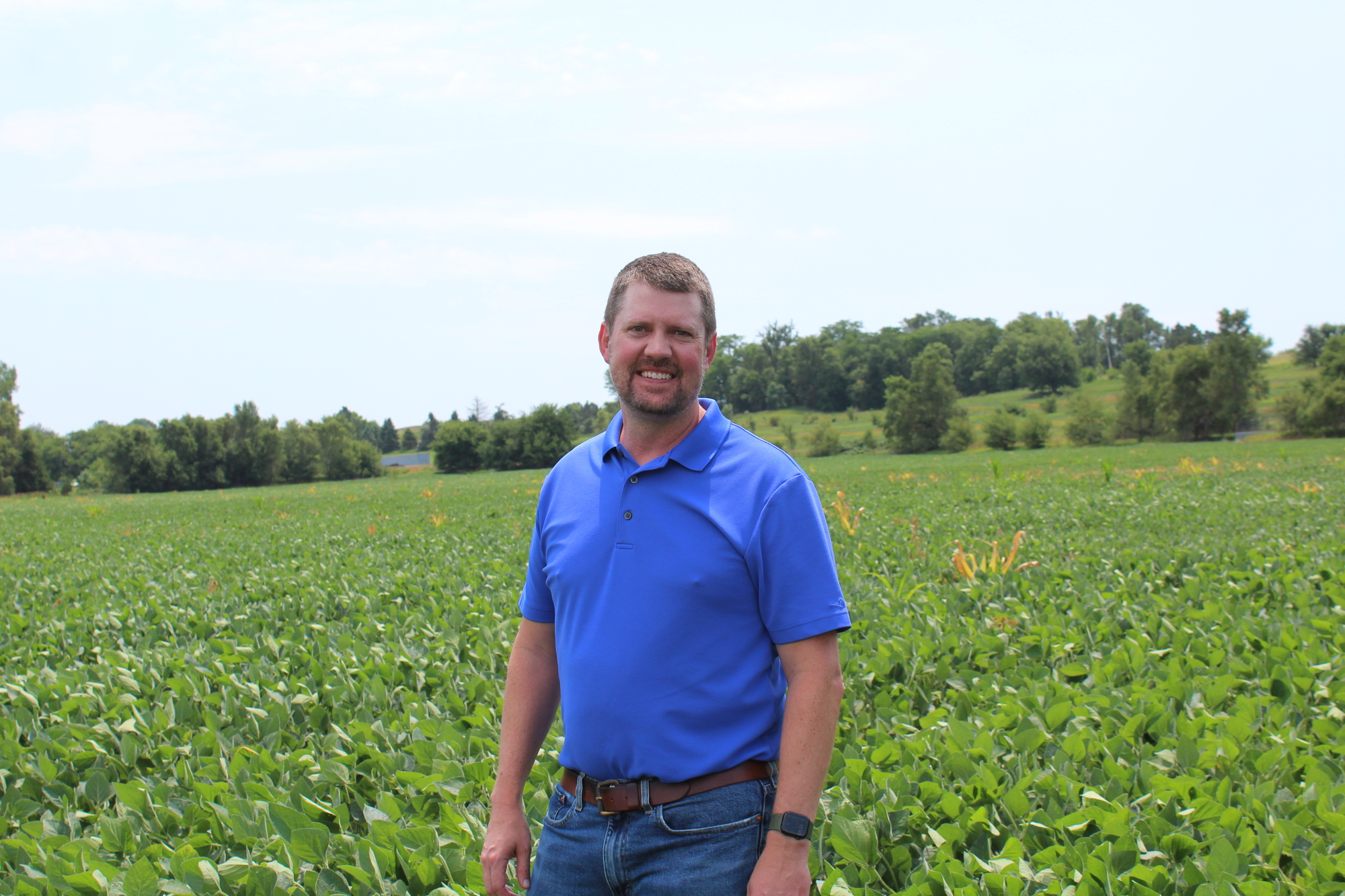
Nathan Mueller knows firsthand that adopting conservation practices is rarely as simple as reading an article or walking into an Natural Resources Conservation Service (NRCS) office. It requires trial and error, financial risk, and a willingness to stand out.
This is where he, as a mentor in the Nebraska Conservation Mentorship Network, steps in. With a career that spans the Nebraska Extension system, a past role as a Statewide Soil Health Specialist for the NRCS, and a hands-on role as a producer, Nathan embodies the bridge between agronomy and the muddy-boots reality that the network champions.
Walking the walk
Nathan’s story reflects a path familiar to many who grow up in rural communities. Raised on a diversified family farm in Washington County, he found himself drawn to understand the relationship between soil and plant health.
Like many young producers, he was concerned that the family farm might not have enough financial margin to support the next generation. He left the farm to attend university, studied agronomy, and stepped onto a career path centered around helping other producers across the state and region.
However, the pull toward farm ownership never left him or his brother, Philip. Though Nathan describes their current operation as small, totaling less than 100 acres between owned and rented ground, it serves as their living laboratory.
While Philip manages the economics side of the ledger, Nathan acts as the hands-on agronomist. This balance allows him to speak to other producers interested in implementing conservation practices on their operation through a practical lens. He knows what it means to write the checks, scout the fields, and manage financial and agronomic risks simultaneously.
Rather than jumping into a complex regenerative framework, Nathan and his brother waded in systematically. Their first step was partnering with the Lower Elkhorn Natural Resources District (NRD).
Nebraska’s NRD system is watershed-based, locally funded, and offers targeted incentives to help producers trial new concepts with reduced financial exposure. The brothers signed up for a two-year NRD program to plant wheat as a winter cover crop.
In their second year of winter wheat cover crop, following a torrential spring rain, Nathan noticed an immediate difference in their fields. Their soil had not crusted over, a common issue in silty clay loam soils that can impede emerging crops.
However, right across the fence line, neighbors without cover crops were facing significant crusting.
This evidence prompted them to transition into a five-year Conservation Stewardship Program (CSP) contract administered by the NRCS. Over the course of that contract, they fine-tuned their cropping system and finished anchoring a steep two-acre bluff along the Elkhorn River by converting it to a pollinator strip.
The practices they implemented during that time remain as they had proven their economic and environmental value.
Learning and leading through experimentation
Having viewed federal conservation programs from both sides of the desk, Nathan’s primary piece of advice for navigating federal conservation programs is simple: just ask.
While national agencies require consistency to protect taxpayer dollars, Nathan realized during his time working inside the NRCS that there is more flexibility than most producers think.
Contracts are not set in stone, and local offices are open to making amendments when Mother Nature disrupts plans. He encourages farmers to enter the office with a five-year vision, openly discussing what operational flexibilities they might need so staff can steer them in the right direction.
Mentorship isn't just celebrating bumper crops; it is also being honest about failures.
Nathan candidly shares the steep learning curve that comes with transitioning to a soil health management system. For instance, the brothers have found massive, repeatable success "planting green"—drilling cash crops directly into a living, standing cover crop in the spring—with soybeans.
However, their experience with corn yielded tougher lessons, as they battled wheat stem maggot, an insect that used the late-standing small-grain cover crop as a bridge into their emerging corn, costing them a few thousand plants per acre.
Rather than scrapping winter wheat or triticale in their cover crop plan, Nathan’s operation is adapting, shifting their termination window for corn to break the pest cycle while safely keeping the late termination, green-planting practice for soybeans.
He also looked for ways to offset input costs through collaboration, partnering with a neighbor who operates a cow-calf operation. After harvesting their winter wheat, the brothers planted an annual forage crop of oats, which the neighbor baled for feed.
This partnership covered their seed and input costs while keeping a living root in the ground to suppress weeds late into the autumn.
Seeking support from others
For producers considering new regenerative practices, Nathan offers a framework based on his own experience.
Beyond starting small to minimize financial risk, he strongly advocates for utilizing the Nebraska On-Farm Research Network. Often, the hardest person to convince of a new idea is a dad, uncle, or business partner. By setting up a study on just a few acres, producers can bring local data back to the kitchen table, minimizing perceived risk and getting everyone on the same page.
Nathan also emphasizes the value of broadening one's geographical network. Local factors can sometimes breed competitiveness regarding land, yields, and reputation, making it difficult to be transparent with the guy across the road. By connecting with a group like the Nebraska Conservation Mentorship Network, producers can easily communicate with farmers a couple of counties away, making it easier to have open, honest dialogue about mistakes and victories.
There is no one-size-fits-all roadmap for soil health in Nebraska. A practice that yields record-breaking corn in one county might drain vital subsoil moisture in another. That is why the network connects producers with experienced, compensated mentors who understand specific regional soil types and local climates.
Operating on a flexible format, the network allows producers to reach out directly with questions, attend local field days, or request one-on-one mentorship.
Ultimately, the learning flows both ways. Nathan notes that even after 20 years in his career, he still gets questions from producers that he has never been asked before.
By becoming a network mentor, he expects and hopes to learn alongside those he advises. No one has to innovate in isolation. Joining a community of like-minded peers allows Nebraska's producers to protect their bottom lines and rebuild the resiliency of their soil.
To learn more about the Nebraska Conservation Mentorship Network and connect with a mentor like Nathan, visit cfra.org/cmn.