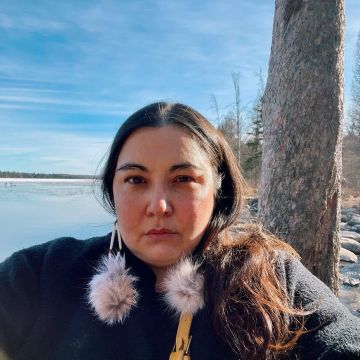
Sikowis Nobiss (Nêhiyaw/Saulteaux) loves her people and has an innate love for the land, especially the prairie. However, she sees a lot of injustice in the world.
She is taking a stand against environmental and social harms, as the founder and executive director of Great Plains Action Society, an organization doing work in Iowa and eastern Nebraska.
“We need to have Indigenous stewardship back to restore what’s been lost and to save what we can,” said Sikowis. “We are in end-stage environment at this moment.”
She founded Great Plains Action Society to represent Indigenous voices on environmental justice and social justice issues.
“Iowa desperately needs the voices of Indigenous peoples in order to survive in my opinion,” Sikowis said. “Great Plains Action Society is a small grassroots Indigenous led organization doing some unique and unprecedented work in a place where our voices are very much erased and where our opinions are very much unwanted.”
Sikowis’ efforts and passion for her work are why she is a recipient of the 2024 Environmental Leader Award, an independent project administratively supported by the Center for Rural Affairs and made possible by the Walton Family Foundation.
The award honors accomplished leaders in the field of environmental stewardship, as well as recognizes individuals with a proven track record and promise of future advancement in the field, prioritizing individuals who work in rural communities.
"I appreciate this recognition as an Indigenous leader, because for me it’s a win for Indigenous women,” Sikowis said. “Just one more step up the ladder.”
Environmental justice, Sikowis said, means cutting to the heart of the problem, understanding the fundamental issues of why we’re facing climate change and environmental degradation. She said it’s very much connected to social issues.
Great Plains Action Society works from an Indigenous world view with traditional ecological knowledge as their base. Staff take action alongside communities, asking what they need. They then provide cultural resources for cultural revival as well as health and healing resources.
And, rematriation is at the heart of everything they do.
“Rematriation is more than just land back. It’s also about reestablishing what’s been lost—the prairie for instance,” Sikowis said. “The buffalo, clean waterways, different types of plants that we used to eat and used to sustain us but no longer exist because monocropping has taken over.”
She said their work is also about bringing back the matriarchy.
“I believe that our world is best run with a matriarchy,” Sikowis said. “Not because it’s in opposition to a patriarchy. It’s not about women running the world, it’s about looking at it from a lens that a woman would look at a household in. How does a mother treat everybody in the home? She tries to make sure everybody is secure and safe and happy and healthy. And that’s what a matriarchy does.”
Sikowis is passionate about working for all Indigenous peoples who face high rates of domestic violence, police murder, being murdered or going missing, and dependence issues. Native communities are often in food deserts and rural areas.
“We know firsthand how difficult it is to be Indigenous in this world,” she said. “To be born Indigenous is a political act—I always tell people that.”
Advocating for the missing and murdered has naturally become a part of Sikowis’ work.
“You can’t talk about environmental justice without talking about Missing and Murdered Indigenous relatives because they are so intricately linked,” she said. “The reason why we have folks in these situations is because so much has been taken from us as Indigenous peoples. When you take the land and the culture, through boarding schools and residential schools, we lost so much. And we have a lot of people who are suffering from genocide sickness still, colonization sickness. That puts them in vulnerable positions where I feel predators can more easily access them and harm them.”
She said it’s more than people being murdered and going missing, it’s about suicide and about people dying from high rates of cancer.
“It’s more than just what people imagine, I think,” she said. “We have the highest rates of youth suicide in the country. We have such high rates of cancer and diabetes and heart disease because we’ve been basically experiments for the government, our lands have been dumping grounds for the government and corporations. Just because we’re not considered fully human beings in a lot of cases.”
Sikowis received her master’s degree at the University of Iowa, and after she graduated, she felt lonely. Originally from Winnipeg, Canada, she was used to a higher percentage of Indigenous neighbors.
“I just felt the need to connect with our urban Native communities and just Native people across Iowa,” she said. “To bring us together and build a more intact or a more close, build a closer community across the state.”
She started hosting “hang outs” at her house between 2010 and 2014. When the fight against the Dakota Access Pipeline occured, first in Iowa, then at Standing Rock, she got involved in that.
People asked how they could help, and Sikowis began to accept donations, creating a Facebook page to keep people updated. Then, she started a resistance camp in Iowa called Little Creek Camp. At that time, she saw the need to become a nonprofit which evolved into the Great Plains Action Society.
When Native leaders work on environmental issues, Sikowis sees opportunities.
“We need people to be in political positions, trying to change legislation,” she said. “We need people to be scientists who are testing the soils. We need entrepreneurs who believe in sustainability. We need activists to push back at the front lines. We need healing justice advocates to heal everybody from this horrible lifestyle that’s been inflicted upon us by the colonizers. We need people everywhere to make a difference. And, most importantly, we need people to steward the land and to grow the food. To bring back the buffalo and to do these things in regenerative and ecological ways.”
Staff at Great Plains Action Society are currently working on purchasing land in Iowa City and starting a resilience and innovation hub. The work is not done.
“I just feel, from the very deepest part of my soul, that I was meant to do this,” she said. “My ancestors put me on this path. They keep me on it. And, of course I’ve got children and I do this for them.”