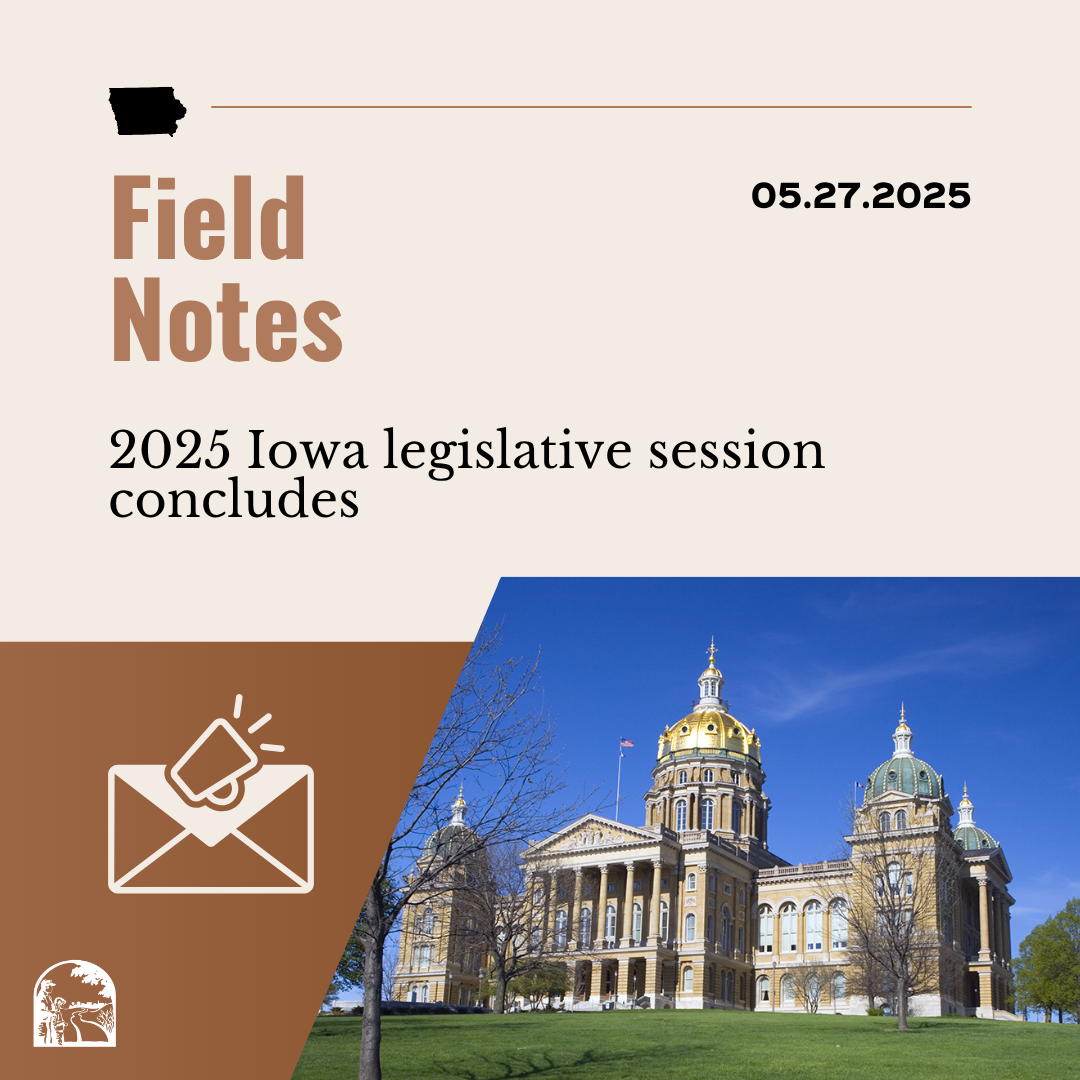
Legislators adjourned for the final time of the 2025 Iowa legislative session on the morning of Thursday, May 15. For bills passed by both the House and the Senate, the governor has until June 15 to sign or veto.
The bill to create the Grocer Reinvestment and Local Produce Processing Funds and Programs (House File, or HF, 1032) did not pass the Senate to have a chance at becoming law. However, we were encouraged by the progress made compared to last year. This session, HF 1032 passed unanimously out of the House and the contingent Fiscal Year 2026 funding language was included in both the House and the Senate Economic Development Budget bills.
Next year's efforts will pick up where we left off, as the 2026 legislative session will be the second year of the General Assembly. For HF 1032 to become law next year, it must pass through the Senate. To fund the program, language must be included again in the appropriations process.
Other relevant bills we were tracking include the governor’s energy bill, which did not advance out of the House or the Senate, and the pharmacy benefit managers (PBM) reform bill, which has been sent to the governor’s desk.
The Center will continue to meet with local leaders, legislators, and advocates over the interim to discuss potential efforts to further support rural communities in Iowa.
As we conclude our regular updates for this year, we extend our sincere appreciation to all of you for following along this session, engaging with your lawmakers, and caring about the issues that impact rural Iowa. As we look ahead to 2026, please don’t hesitate to reach out to me at [email protected] or 402.687.2100 ext. 1034 to make your rural voice heard.
Rural grocery / local food
HF 1032 (previously HF 550 and HF 59) – Support: Introduced by Reps. Brian Lohse and Chad Ingels, this Center priority bill creates the Grocer Reinvestment Program and the Local Food Processing Program. The legislation directs the Iowa Economic Development Authority to create a grant program for new or current grocery stores. Prioritization is given to projects focused on cost-saving efforts and business efficiency measures to ensure the long-term sustainability of stores. Grants are directed to help small, locally owned grocery stores sell perishable foods in rural communities. The bill does not include a population requirement and instead calls for priority to be given to rural communities, and the definition of grocery stores includes businesses that sell more than groceries, such as a deli or restaurant. The local produce processing grant program will be overseen by the Iowa Department of Agriculture and Land Stewardship.
Status: Passed out of the House unanimously but did not pass out of an Appropriations subcommittee in the Senate. The Economic Development Budget, SF 645, included contingent funding for FY26, so the funds will not be eligible to fund the program next year.
SF 232 (previously Senate Study Bill [SSB] 1012) / HF 920 – Support: Introduced by the Senate Committee on Health and Human Services (HHS) by Chairperson Mike Klimesh and by 33 representatives in the House, this bill allocates funding to the Iowa Healthiest State Initiative to administer Double Up Food Bucks. This program doubles the investment for purchases of fruits and vegetables by Iowans participating in the Supplemental Nutrition Assistance Program (SNAP). It also specifically benefits local food producers who accept SNAP at farmers markets, grocery stores, and other local places of sale.
Status: Passed out of the Senate Health and Human Services Committee but did not pass out of the Senate Appropriations Committee. Passed out of the House Health and Services Committee but did not pass out of an Appropriations subcommittee in the House.
HF 970 (previously HF 796 and House Study Bill [HSB] 216) – Monitor: Introduced by the House Committee on HHS by Chairperson Carter Nordman, this bill is similar to SF 232, also allocating funding to the Iowa Healthiest State Initiative to administer Double Up Food Bucks. However, there is an additional piece requiring Iowa HHS to request a waiver from the U.S. Department of Agriculture Food and Nutrition Service, providing limitations on eligible food purchases.
Status: Passed out of the House on a vote of 56-40 but did not progress any further in the Senate.
HF 1006 (previously HF 179 and HF 32) – Monitor: This legislation distinguishes two separate categories for food processing licenses: a category in which meat or poultry is processed on a farm or private residence, and a general category including all other processing locations. In 2023, the general assembly revised the methods used to calculate the annual license fees imposed on food processing plants. The updated correlating license fee structure is included in the bill.
Status: Passed out of the House on a vote of 90-1 but did not progress any further in the Senate.
SF 525 (previously SSB 1158) / HF 851 (previously HSB 173) – Monitor: Introduced by Senate Committee on Agriculture by Chairperson Dawn Driscoll and House Committee on State Government by Chairperson Jane Bloomingdale, these companion bills require education on nutrition, agriculture, food, and natural resources to K-12 students related to the career and technical education components of instruction. They also require the Department of Education to apply for a waiver to update nutritional guidelines, creating exemptions for school lunch recommendations and prioritizing food groups in the following order: animal-based proteins, dairy products, vegetables, and fruits.
Status: Passed out of the House on a vote of 60-36. Passed out of the Senate Agriculture Committee but did not progress any further.
Water quality
Senate Joint Resolution (SJR) 6 – Monitor: Introduced by 17 senators, this bill repeals the natural resources and outdoor recreation trust fund from the constitution and directs funds from an increased sales tax for the benefit of property tax relief.
Status: Passed out of a Senate subcommittee but did not progress any further.
HF 329 – Undecided: Introduced by Rep. Mike Sexton, this bill relates to the distribution of water exempt from taxation and the use of tax exemption certificates. With definitions for water utility and exemption certification provided, the bill requires a water utility to accept and retain a valid exemption certificate, rather than receiving the exemption itself. The water utility shall not unnecessarily require a person who presents a valid exemption certificate to obtain a sale or water service refund from the Department of Revenue. After attending the House subcommittee meeting, Center staff learned this bill was requested by Iowa Select Farms and may no longer be needed based on new interpretations of the current Iowa code.
Status: Passed out of a House subcommittee but did not progress any further.
HF 1033 (previously HSB 226) – Undecided: Introduced by the House Committee on Ways and Means Chairperson Bobby Kaufmann, this bill makes rural water districts a designated exempt entity for sales and use tax purposes. Center staff know rural water districts provide drinking water where private wells and municipalities do not. This bill cleans up the confusion the current code causes by allowing all purchases by rural water districts to be tax-exempt.
Status: Passed out of the House on a vote of 86-4 but did not progress any further.
Renewable energy
HF 834 (previously HSB 123) / SF 585 (previously SSB 1112) – Undecided: Introduced by Gov. Reynolds, these bills address a variety of energy and utility issues, including a new requirement for public utilities to file Integrated Resource Plans every five years with the Iowa Utilities Commission, a process commonly found in other states. While the bill creates more transparency for future energy plans, the legislation does not allow official public input in the process. Another key update provides further protections for farmers by requiring transmission line developers to uphold certain land restoration standards, an idea supported by the Center. The bills passed out of their respective House and Senate Commerce Committees. As companion bills, they are headed to their respective Appropriations Committees for more work on the Integrated Resource Plan components and other ratepayer issues.
Status: Did not pass out of a House subcommittee. Passed out of a subcommittee in the Senate but did not progress any further.
Other bills of interest
HF 369 (previously HF 33) – Support: Introduced by Reps. Chad Ingels and Shannon Latham, this bill establishes an agriculture education grant program to expand high school students’ access to instruction related to agriculture, food, and natural resources.
Status: Passed out of a House subcommittee but did not progress any further.
SF 383 (previously HF 852, HF 99, and SSB 1074) – Support: Introduced by House Commerce Committee Chair Rep. Shannon Lundgren and Senate Health and Human Services Committee Chair Sen. Mike Klimesh, this bill relates to pharmacy benefits managers, pharmacies, and prescription drugs. Fair pricing requirements allow rural pharmacies to be competitive and stay in business, preventing more areas of the state from losing local pharmacy services.
Status: Awaits the governor’s signature.
HF 1001 (previously HF 209 and HF 15) – Undecided: Introduced by Rep. Brian Lohse, this bill creates a rural attorney recruitment assistance program. Rural counties and municipalities recruiting attorneys to practice in their areas would be eligible to apply for financial incentives through the College Student Aid Commission, providing program requirements are met. Center staff are researching the potential impact of this legislation, as it limits assistance to no more than five attorneys across the state.
Status: Passed out of the House on a vote of 86-6 but did not progress any further.
HF 143 – Support: Introduced by Rep. Devon Wood, this bill creates a rural veterinary practice innovation and revitalization fund and program. Funding would be appropriated to assist veterinary practices in rural counties.
Status: Did not pass out of a House subcommittee.
HF 235 – Undecided: Introduced by Rep. Henry Stone, this bill changes the general and rural county services levy rate limitation for upcoming fiscal years, allowing counties to adjust levy rates if property tax income is equal to or less than the expected general county service expenses. Center staff are monitoring this bill to better understand the monetary consequences for counties that have declining property tax income.
Status: Did not pass out of a House subcommittee.
SF 270 / HSB 274 – Support: Introduced by Sen. Mike Klimesh and House Ways and Means Committee Chairperson Bobby Kaufmann, these bills create the Iowa Rural Development Tax Credit Program. Through an application process, the Iowa Economic Development Authority could award tax credits to qualifying businesses for investing in special capital contributions in rural areas.
Status: Did not pass out of a Senate subcommittee. Passed out of a House subcommittee but did not progress any further.
SF 632 (previously SF 522 and SSB 1160) – Undecided: Introduced by the Department of Agriculture and Land Stewardship, this bill seeks to clean up some parts of the Iowa Code and make changes to a few sections, including those covering crop production nutrient application, animal health, and foreign disease threats, and agriculture food processing and licensing fees.
Status: Signed into law.
HF 624 (previously HF 56) – Support: Introduced by Reps. Bill Gustoff, Derek Wulf, and Megan Jones, this bill allows net income earned, received, or reported from farm tenancy by an S corporation, a trust, or an estate to be excluded from a farmer’s taxable income. To be eligible, the farmer must have held the property that is under tenancy for 10 or more years.
Status: Passed out of the House unanimously but did not progress any further.