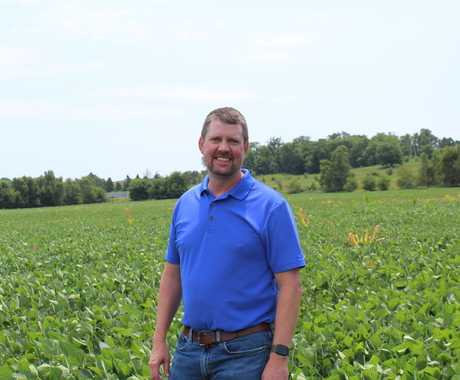

As a beginning farmer in Fayette County, Iowa, Trent Woltzen farms alongside his dad, raising cattle, goats, corn, soybeans, and hay. However, even with the support of family, opportunities to rent or purchase land of his own and contribute to the growth of the family farm have been limited.
Fortunately, the Conservation Reserve Program - Transition Incentives Program (CRP-TIP) has helped him connect with local landowner Levern Thyer.
Levern owns approximately 400 acres 10 miles south of Trent. He rents out most of the acres for row crop production and raises a handful of cattle with his son Curtis, who works off the farm full-time.
In the past, Trent has sold Curtis hay for the cattle. A few years ago, Curtis mentioned that Levern was looking for a new tenant. Although the mention was just in passing, it led to meaningful growth for Trent and a land transition contract through CRP-TIP.
Administered by the U.S. Department of Agriculture’s (USDA) Farm Service Agency (FSA), CRP-TIP creates a unique opportunity for beginning farmers seeking land and landowners looking to retire without a next-generation family member to take over the farm. The program provides two years of additional CRP payments to a landowner who sells or long-term leases their expiring CRP acres to a beginning or underserved farmer or rancher. The program brings CRP land back into agricultural production under an approved conservation plan implemented by the new operator.
Although new sign-ups for CRP-TIP have been on hold since early 2025, existing contracts continue to support beginning farmers and landowners like Trent and Levern.
Relationships are key
Relationships with neighbors and local FSA staff are necessary to develop a successful operation, especially for beginning farmers and ranchers working to set out on their own.
Trent’s relationship with Levern stems from many conversations and positive interactions over the years. Now, through CRP-TIP, Trent has a rental agreement with Levern to farm the acres that came back into production two years ago.
As Trent solidified his relationship with Levern, he turned to the nearby USDA service center for support in navigating the federal program.
“The ladies at the office there in West Union have also been really great to work with,” Trent said of his local FSA staff. “They let us know what paperwork needs to be completed and make sure we understand what we’re signing up for.”
Transition out of CRP, conservation is a must
Of the 80-acre parcel previously enrolled in CRP, Trent is growing crops on about 30 acres of it. The other 50 acres remain in CRP and include two ponds to slow down water coming onto the property off the hilltop.
“It’s not bad that we don’t farm some of it,” Trent said. “The piece is super hilly, so I also knew some work was going to be needed to take care of it.”
As Trent brought the ground back into production, he updated the conservation plan at the USDA office to include a number of practices.
Contour strips were previously used on the parcel, so Trent chose to plant them again. This practice involves cultivating strips for crops between strips of grasses or legumes. Placing the strips along the contour of the land, instead of up and down a hill, slows water runoff and reduces soil erosion.
“We worked with Luanne at the FSA office to tweak some of the flags for the contour strips,” Trent said. “We left some of the areas where it’s super steep to prevent washing [of soil].”
Additionally, Trent is using crop rotations and vertical tillage to follow through on his conservation plan to improve soil fertility and decrease disruptions to the soil. Trent has found they work well for his parcel, in addition to the other acres he farms with his dad.
Meaningful program and opportunity
Instead of charging Trent full rent during the first two years of the CRP-TIP contract, Levern only required payment for the remainder of the market cash rental price after subtracting the CRP payment. The rent payment ended up minimal due to the value of the previous CRP rental payments.
As they move into year three of the five-year contract, Trent will be required to pay the full rental price. From Trent’s perspective, this has worked out well for him.
“I was able to ease my way into payments,” Trent said. “It saved me money in the long run because I was able to build up to paying the full rent for years three, four, and five of the contract.”
For Levern, CRP-TIP was a great option financially. Although he charged very little rent for Trent to farm the ground the first two years, Levern did not lose money because the CRP payments covered the rest. He has been grateful for the opportunity to work with a local beginning farmer.
“I wasn’t out to make money,” Levern said. “It’s good for young farmers; otherwise I wouldn’t have done it with Trent.”