Published in the Monticello Times, Monticello, Minnesota, on June 11, 2026.
Across Minnesota, farmers, landowners, and rural communities are taking a closer look at how solar development can work alongside agriculture instead of competing with it.
Agrivoltaics, or dual-use solar, is growing interest as people look for ways to keep land productive, support conservation, and create new opportunities. Agrivoltaics includes beneficial practices such as growing crops beneath panels, grazing livestock on solar sites, and the inclusion of pollinator habitat.
Minnesota has 260 agrivoltaics sites, which generate 1,228 megawatts and encompasses 7,169 acres. For comparison, there are 666 agrivoltaics sites in the U.S., so Minnesota alone makes up almost half of those.
In the Big Lake Township of Sherburne County lies USS Big Lake 1 LLC (“Big Lake”), developed by U.S. Solar in 2017. The project is situated on roughly 9 acres of an 18-acre property owned by U.S. Solar.
The site is considered to be located on marginal land due to the sandy soil contributing to poor nutrient content and low water holding capacity. The land is prone to erosion, making it less suitable for traditional agriculture and leading to lower crop yields compared to other soil types.
“Locating a solar project on sandy soil and coupling it with beneficial vegetation offers the opportunity to reduce soil erosion, attract pollinators, and limit water loss,” said Cora Hoffer, senior policy associate with the Center for Rural Affairs.
Bring on the bees
Once it was sited for solar development, U.S. Solar installed native pollinator habitat on all 18 acres and planted more than 100 coniferous trees to help screen the project from nearby roadways.
In 2019, in partnership with Bare Honey, beekeeping began on the site to take advantage of the pollinator habitat. In 2023, U.S. Solar entered a partnership with Big River Farms, a program of The Food Group, to provide access to farmers to grow vegetables in between rows of the solar facility.
“Prioritizing siting solar energy projects on low-quality agricultural land offers another stream of income to landowners, protects and increases the health of the land by minimizing soil disturbances,” Hoffer said.
Raise the ruminants
While Big Lake uses bees and vegetables beneath its solar panels, Cannon Valley Graziers in Northfield use sheep and goats.
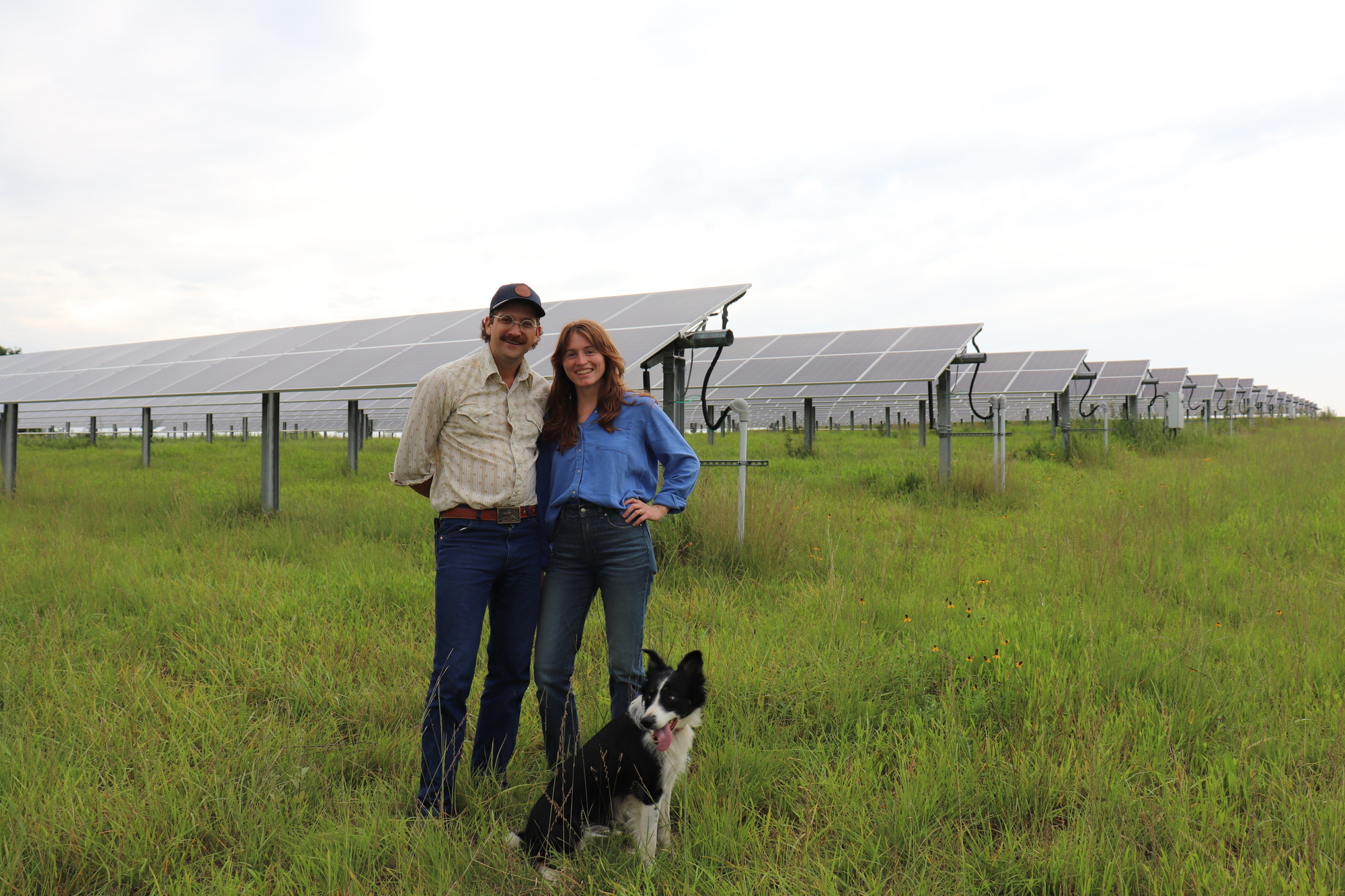
Owners Arlo Hark and Josie Trople began in 2018 with the mission of using livestock to create a tangible, positive impact on the soil health, water quality, and biodiversity of their region.
Over the past several years, Cannon Valley Graziers has watched the industry change and, with that, so has their business. Cannon Valley Graziers has grown from managing a flock of 20 sheep to now managing over 2,200 head of sheep and goats. In 2024, they grazed just under 2,000 acres of solar projects throughout the Upper Midwest.
According to the American Solar Grazing Association in October 2024, nearly 130,000 acres of solar sites were being grazed in the U.S. by more than 113,000 sheep. The scale of solar grazing is undergoing rapid growth which opens opportunities for the sheep industry.
By integrating targeted grazing into traditional land management, Cannon Valley Graziers is able to meet vegetation management requirements of the solar industry while supporting native ecosystem function on solar sites, promoting soil health and water quality. In addition, they produce lamb and wool. This model creates new revenue streams for graziers and strengthens the economic viability of the sheep industry. Rather than relying solely on commodity markets, graziers can be compensated for the ecological benefits they deliver.
Lead the learning
To help understand the economic and environmental benefits, the Center for Rural Affairs has developed a webinar series focused on research, real-world examples, and producer perspectives.
The first video introduces the Center’s comprehensive set of resources for the public and local decision makers, including siting resources and model ordinance language.
The second explains the basics of agrivoltaics and shows how solar systems can work alongside conservation practices, grazing, and crop and vegetable production on working lands.
The third features panelists who discuss cattle voltaics, specialty crop production, and emerging agrivoltaics research. One of the panelists, Dr. Brad Heins of University of Minnesota-Morris, talks about the research his students are completing on cattle grazing in solar fields.
“As interest in solar continues to grow, the Center’s resources can help producers and community members better understand what is possible on the ground,” Hoffer said. “Hearing directly from researchers, educators, and practitioners can help move the conversation beyond assumptions and toward practical possibilities.”
Find out more at cfra.org/agrivoltaics.
Rhea Landholm contributed to this article. Feature photo is of Arlo Hank and Josie Trople, Cannon Valley Graziers. | Photo by Rhea Landholm