Shopping at a small town grocery store is more than just buying food; it’s chatting with a neighbor in the middle of the aisle, picking up the final ingredient to finish cooking dinner, and seeing a familiar face smiling at you from behind the cash register.
After the grocery store in Emerson, Nebraska, closed, those seemingly simple, but important, experiences were lost. Community leaders were concerned about elderly and food-insecure residents who may be unable to travel to a grocery store, as well as the loss of a vital business and connection point. They reached out to the Center for Rural Affairs for help after researching how the Center helped Cody, Nebraska, with its grocery store in 2009. Center staff assisted Emerson in forming a committee to brainstorm ideas on how to open a new store and solve some of their immediate needs for short-term food assistance.
Staff also provided resources about different business models and invited the Nebraska Cooperative Development Center to help with the community conversations. With community input, they determined that a cooperative, or co-op, business model was an option worth exploring. As producer- and user-owned businesses, co-ops are controlled by their members. In many ways, co-ops are a lot like other businesses: they are located in the same type of buildings or facilities, have to follow sound business practices, and are created and operated for similar purposes.
In this case, Emerson residents wanted to find a way to bring back the small town charm of those friendly encounters as well as maintain access to fresh and staple foods in their hometown.
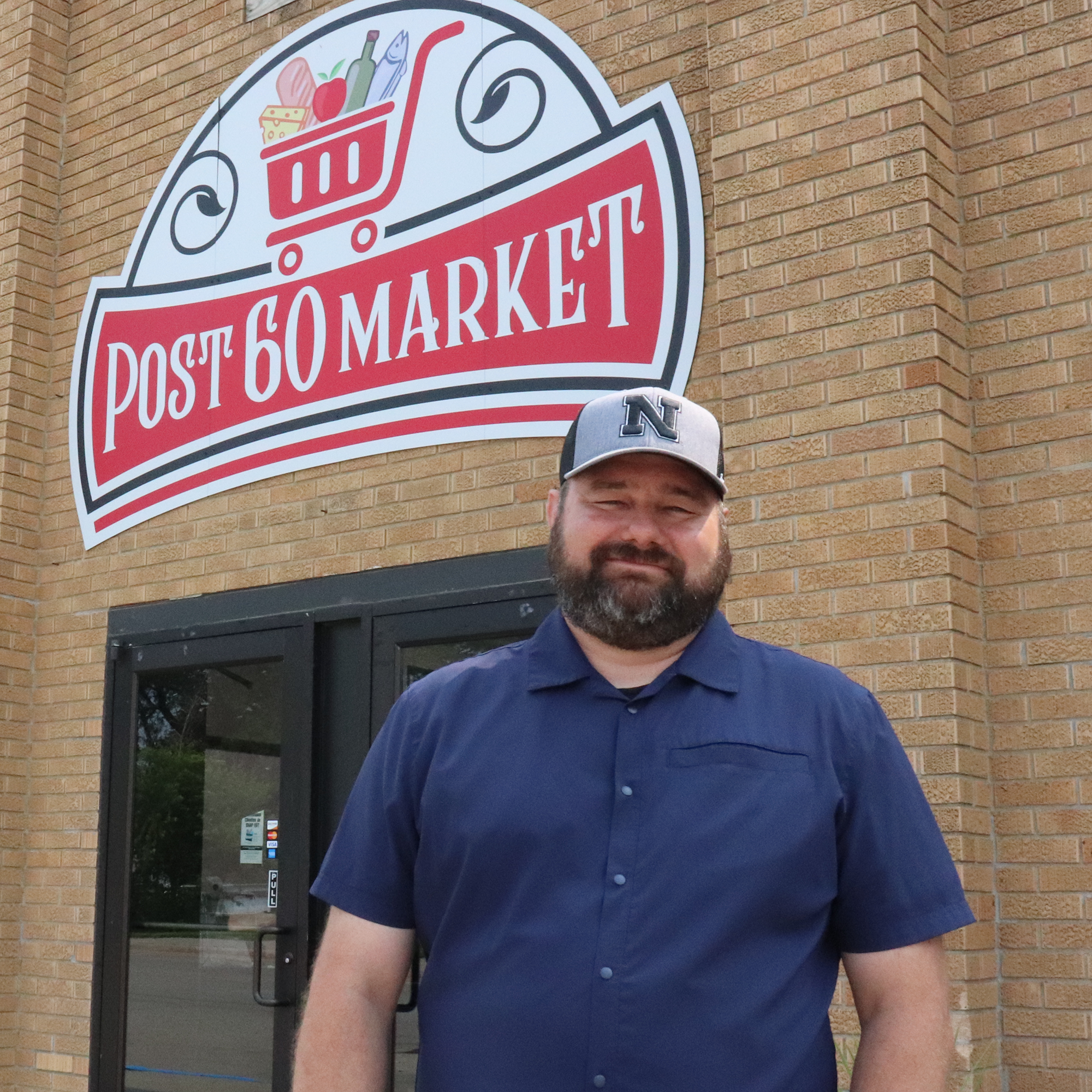
With the financial support of more than 100 investors–most being residents of Emerson and those who grew up there and have since moved away–a board of directors was created, and Post 60 Market opened in 2022. Named as an ode to the American Legion Post, the market is housed in the building the legion once called home.
Upon retiring from the Air Force, Emerson native Brian Horak didn’t plan on moving back to his hometown, or even to Nebraska. But as fate would have it, Brian and his family ended up buying his grandmother’s house when she went into a care facility, and he called the small town home once again.
He already had a job lined up, but once people knew Brian was back in town they asked him if he had any interest in managing Post 60 Market. With previous experience working in both small and large grocery stores and having parents who owned and operated a grocery in Springfield, Nebraska, co-op members knew Brian would have the know-how to run the new store.
“I was approached about running the store, but I wasn’t sure at first,” said Brian. “Small town store ownership is tough. My brother and I actually looked at buying a local store when I retired, but we couldn’t get the numbers to work. But, the town wanted a store, and I had to at least try to help it succeed. I couldn’t drive by that building every day and possibly see it fail knowing I could have helped somehow.”
After Brian agreed to be the manager, he found himself reconnecting and reminiscing.
“I worked here as a kid, and all the same people are still here now,” he said. “I see the same faces after 20 years, and share the same memories with them. You don’t get that in the big stores.”
Brian has seen the store through ups and downs, and worked with investors and board members to build a solid foundation.
“There’s a lot of money on the line,” he said. “Initially, some board members wanted to be involved in everything, but members come and go, and now I feel fortunate that they trust me to make the big decisions.”
Many of those decisions revolve around keeping track of the inventory and making sure customers are able to buy what they want and need most. Finding the right balance of products has been a learning experience for everyone involved.
“If someone I knew was opening a co-op style store, I’d make sure to tell them to watch their initial costs,” Brian said. “The biggest thing we did that cost a lot of money was stock the store with our supplier’s top movers. We learned that just because those are big sellers in Norfolk, where they’re located, doesn’t mean they sell well here.”
If he could do it over, Brian would have bought only the basics to start off with and then gone to his customers for feedback about what they would actually buy.
“That would have saved us thousands and thousands of dollars,” he said. “Everyone wanted to get the store open as quickly as possible, but not everything was in place yet. If we had some of that money, we could have bought other items that we needed, like a walk-in cooler.”
Another trial has been getting fresh bread. No one delivers to Emerson, so Brian drives once a week to nearby Laurel, where a store owner allows him to pick up bread when its supplier comes to town.
“No bread companies want to come here,” he said. “At first, we had to get frozen bread and put them in freezers in the basement of our store. It takes about two hours out of my Thursdays each week to make these bread runs.”
A major bread manufacturer has started a new program that allows Brian to access more products, but the price is higher and the product is smaller. As he tests this out, he keeps looking for better solutions to give his customers the best options.
Challenges aside, running a small town grocery store has plenty of perks, and the store has become more than a place to pick up groceries.
“Since coming out of the COVID-19 pandemic, the elderly folks in town have had a chance to get out more,” Brian said. “Going to the grocery store was the most social interaction they got. I could see that talking in the aisles to people they haven’t seen in six months was the highlight of their day. It’s something you have to see to understand. Grocery stores do more than provide food for people, it’s a social experience and a chance to connect with others.”
Post 60 Market also has led to more growth in Emerson. New life has begun to emerge on Main Street as two new businesses, a coffee shop and an event supply store, have found homes next door to the market.
The town also recently received a large grant to use to revitalize the downtown.
“That probably wouldn’t have happened without the grocery store,” said Brian. “It’s been like a domino effect.”
Currently, Brian is working on an online shopping platform to make the shopping experience more convenient for customers.
“We’ve gotten massive feedback from people that they want to be able to shop online and have groceries delivered,” Brian said. “The younger generation wants things brought to them, and some of the older generation who can’t get out of the house at all could really benefit from it, too.”
Between brainstorming new ideas and taking care of day-to-day operations, Brian also finds time to take care of building maintenance, technical issues, and whatever else is needed at any given moment. He does it all without complaint because he cares about his hometown.
“Our philosophy with the board of directors and investors is first and foremost to serve the town,” Brian said. “Secondary to that is to make money. We all put our own money into this store to get it going, and no one is really expecting that money back. It was a joint investment within the town to make sure Emerson residents don’t have to travel miles and miles to get what they need.”