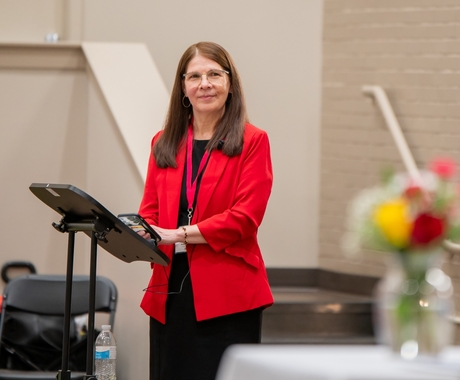

With a background in social work, Jessi Chandler Mason has discovered more than one way to serve her community.
She owns The Market and Mill, a grocery store, coffee shop, community gathering place, lunch spot, school bus stop, community kitchen, museum, and more, in her hometown of Anselmo, Nebraska.
Along with addressing needs in her community, Jessi testified at the state legislature on a bill that would invest in rural grocery stores.
When the Nebraska Grocer Reinvestment Option Act was introduced in spring 2024, Jessi stepped up to share her experience. The act would have established a grant and loan program to help locally owned grocery and convenience stores selling perishable foods invest in their businesses.
For her efforts, Jessi has been awarded the Center’s Citizenship Award, which is given to an individual or individuals who actively participate in the civic process of creating public policy, and who work closely with the Center to advance public policies that strengthen family farms, ranches, and rural communities.
“Jessi was a social worker before becoming a grocer, which brings a unique perspective to her experience, bringing a deeper understanding of the role a grocery store plays in rural communities,” said Carlie Jonas, policy associate with the Center. “Besides being a place to buy essential groceries, she also views these stores as an important part of meeting the social and health needs of a community.”
Surprising life path
Jessi’s goal in high school was to leave Anselmo and never return, but that idea didn’t last.
In college, she took awhile to figure out what path she wanted to take. Eventually, she graduated with a degree in family science with minors in psychology, sociology, and gerontology. Then, she earned a master’s degree in social work and followed that career trajectory.
“I’ve worked in every setting, like refugee resettlement, domestic violence, and medical social work; I’ve worked with support groups like aging mental health services, a lot of different things,” Jessi said.
When she and her husband, Andrew, had their first son in 2013, they were living in Lincoln with no family nearby.
“It didn’t feel right to raise our son there,” Jessi said. “We realized that it takes a village and we wanted to be closer to my family. So it was a pretty quick decision to move back.”
The move to the Anselmo area happened fast. Within one day, both Jessi and Andrew had job offers, and they had a house out in the country.
In February 2020, Jessi gave birth to their fourth child, and then the COVID-19 pandemic hit.
“It was such an isolating experience; all I could think about is that I am a young woman and I’m isolated out here,” Jessi said. “Then I started introspectively trying to figure out what it is that we need to do to battle this isolation.”
Her first thoughts went to Maslow’s Hierarchy of Needs, a psychological theory that organizes human needs into five levels.
“Before you can fulfill all these other things in your community, you have to have the basic necessities,” Jessi said. “And at that time, the grocery store was up for sale and so I threw the idea around with my husband. He was like, yeah, go for it.”
Becoming a grocery store owner
Jessi wanted to make sure community members not only had a place to buy food, but a place to gather. And as a business owner, she felt the need to improve the building and the offerings.
“I never intended to own a grocery store, but our goals here are to support local and to grow local as well as regenerate the very values in the community that make us love our rural way of life,” Jessi said.
One of the first things she did was add a coffee shop. Even school children gather in the morning and evening since The Market and Mill is a bus stop.
“Part of our goal is to make it feel like a really small little quaint market that you almost feel like you’ve been here before,” Jessi said. “It’s kind of like a hug when you walk in.”
There is not a typical day when it comes to running a grocery store, she said.
“I can be the meat cutter, barista, the floor mopper, and I could be checking out people all within five minutes,” Jessi said. “But that also makes our rural grocery store so special. You can go up to any one of my staff and they know the ins and outs of all of it.”
She also deals with an old building, coolers and freezers that need replacing, and thin profit margins.
“Our profit margins are so low in a grocery store that you really need to think outside the box and figure out other ways to bring in income or you’ll struggle regularly,” Jessi said. “Every day or every week, when looking at numbers, I’m thinking what’s the next thing that we can do, or what is it that our customers have been asking for, and is this going to help our profit margins?”
She’s had volunteers pitch in, making The Market and Mill a community effort. Many of the renovations have been completed by people lending a helping hand.
You’re not alone
Last year, Center for Rural Affairs staff reached out to several rural grocery store owners to talk about the proposed Nebraska Grocer Reinvestment Option Act and to listen to what the entrepreneurs were experiencing.
“I’m so thankful for you guys,” Jessi said. “Because at the time you called, we were at a point where I’m doing renovations in the back, and it was just a day-in-and-day-out grind. While I love advocacy and I’m happy to help, we were in such a rut that I would’ve never thought to go and do it myself. That puts me out of my comfort zone, and it feels like I’m helping in some way.”
While social work and advocacy go hand in hand, she said, that doesn’t mean testifying at the state Capitol was easy.
“I was super nervous, but God gave me two ears and one mouth for a reason,” she said. “I’m listening to what our customers want. I am listening to what the community wants. I’m engaged. Someone needs to be advocating for our rural communities. It’s important, and I wish people would feel more inclined to use what they know and the experiences they have to do that.”
Jessi’s son Max, who was in fourth-grade at the time, went to Lincoln with her. The school recorded the hearing, then screened it, and Max got to participate in a state policy discussion.
“Running a grocery store takes a lot of time and hard work, but Jessi was enthusiastic about putting that aside for a day,” Carlie said. “She knew it was something important for her to share her experience as a grocery store owner and for her community. She brought her son so he could also experience and learn about the policymaking process, and how everyday people are part of that.”
Jessi went above and beyond, sharing this civic engagement opportunity with her community and mentors, which helped gain more support for the bill. She also shared her experience via The Market and Mill’s Facebook page.
“After the legislative session, she continued to be a dedicated advocate,” Carlie said. “We spoke with her again for our interim hearing, which was included in our final report that was presented to the legislature.”
In addition, Jessi gave a presentation at the Nebraska Grocery Industry Summit, sharing her story, challenges, and improvements with other grocers, government and industry representatives, and staff from elected officials.
Carlie called Jessi early this year to let her know she was the 2024 Citizenship Award recipient.
“I didn’t feel deserving at all,” Jessi said. “Really I’m just a vessel. The Center does all the work, and I’m just happy to share my experience. I think people underestimate the power of their own voice and lived experience.”
The grocery bill did not pass in Nebraska this year, but has the potential to pass next session. No matter the outcome, the Center will continue its grocery store work. Over the past year, the Center created a networking group for independent grocery store owners in Nebraska. Jessi said she has benefited from the virtual meetings.
“The cohort is amazing, I wish every store could be a part of it,” she said.
Thinking out of the box
While Jessi offers a coffee shop and gathering place to members of the Anselmo community, as well as a grocery store, her favorite part of being a business owner is the people.
“Food is a connection; we all need food,” Jessi said.
She has not quite left her social work life behind. She truly cares about everyone in her community and makes time to listen.
Anselmo is on Nebraska Highway 2, the Sandhills Journey National Scenic Byway, which attracts tourists. She’s made an effort to sell locally made products, with plans to create a Nebraska-made display using the back cabinetry of a bar that used to be in town.
Behind the deli counter, Jessi has transformed the kitchen into a facility community members can use. One person serves lunch each Tuesday. Another sells sourdough, taking advantage of the commercial oven and walk-in cooler. The goal is to make it a rent-based kitchen.
Jessi also has created a “fire fund” where, at any time, people can donate. When there is an emergency, such as a wildfire, volunteers have made sandwiches for the firefighters. Two years ago, a nearby wildfire burned about 40,000 acres, and volunteers made nearly 200 sandwiches in 45 minutes.
“It’s another little added bonus to our kitchen that was never intended,” Jessi said. “Every meal that we send out is donated. No one has to worry about paying for it; it’s just a community effort.”
Another product of the kitchen is bull fries, a delicacy of the Sandhills. Local ranchers help slice, tenderize, and bread livestock testicles, using a recipe that has been passed down three generations.
To preserve the history of the town, Barb Pellor, a staff member, has worked with the Custer County Museum to display old photos in the grocery. Visitors can scan a QR for self-guided tours.
“It is to honor the history and memory of our town, where it’s been and where it’s going,” Jessi said.
Along with the old photos, the wall opposite the coffee bar displays historical items, such as letter sweaters from the ‘50s, bricks from the torn-down school building, commemorative plates, class pictures, and more. There’s even an original architectural drawing of Anselmo’s Catholic Church, known as the Cathedral of the Sandhills, a drawing that includes a school that was never built.
In the future, Jessi wants to figure out a way to provide fresher produce to the community. In the summer, she buys from local growers. One possible solution is to set up grow towers in the building’s full basement.
“I know we can’t grow oranges or apples on demand, but we could grow leaf lettuce, radishes, some of those basic things,” Jessi said. “You really have to be creative and thinking out of the box at all times. Especially in our rural stores.”