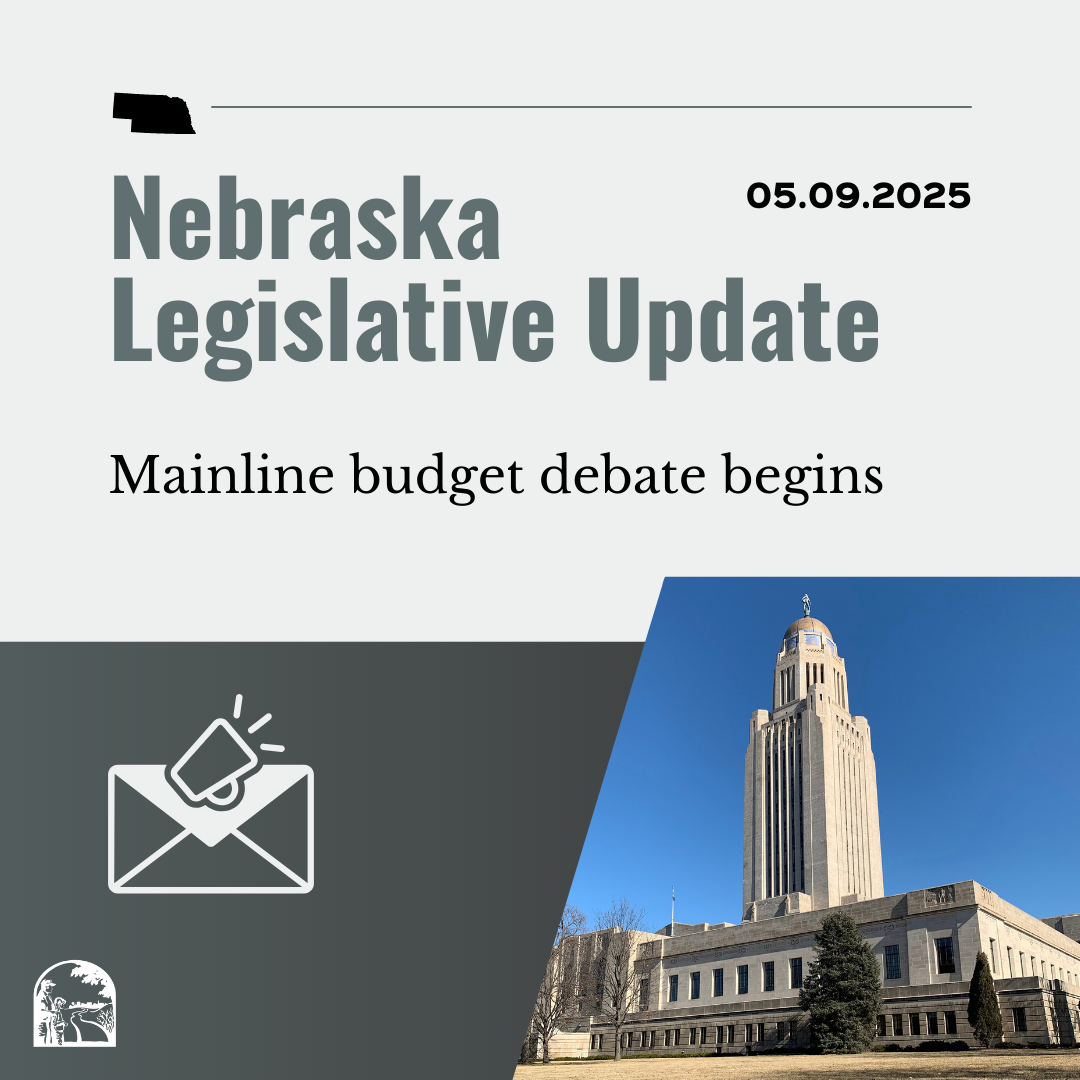
Debate of the mainline budget bills began Tuesday as the Legislature continues to work to close a remaining $262 million budget deficit. Initially, the projected budget deficit was $433 million, so progress has been made, but there is still a long way to go. Reducing or pausing various tax incentives, increasing taxes on certain products and services, and transferring cash reserves to the general fund are all being considered to close the remaining shortfall. Senators have until next Thursday, May 15—the 80th day of the 90-day session—to send their final budget to the governor. The governor then has five calendar days, excluding Sunday, to sign or veto the budget bill.
May 15 is also the final day for senators to introduce interim studies. Interim studies are an opportunity for senators to examine and evaluate public policy issues while the Legislature is not in session. The studies often are used as a basis for legislation during the next legislative session.
We value your input as we engage with the legislative process. If you would like to share your support, concerns, insights, or opposition, or if you would like help connecting with your senator, please do not hesitate to contact me at [email protected] or 402.687.2100.
Economic development
LB 81 (Hardin) – Monitor: During the 2024 special legislative session, senators passed a bill that alterated how and when 2023 property tax credits are applied, resulting in the majority of Nebraska property owners missing out on dollars they otherwise would have had refunded. This bill is a cleanup measure for the affected property owners, but it will have to move through the legislative process very swiftly to be effective. A hearing was held before the Revenue Committee on Feb. 26. This bill is a cleanup measure for the affected property owners, but it has stalled in the Revenue Committee and will be re-evaluated next year.
LB 151 (Cavanaugh, J.) – Support: Creates the First-Time Homebuyers Savings Account to allow tax-deductible contributions to be made into savings accounts up to $4,000 for married couples who file taxes jointly, or $2,000 for other individuals opening a new account. A hearing was held before the Revenue Committee on March 13.
LB 201 (Kauth) – Oppose: This legislation establishes a 10% fee on any money transferred from Nebraska to an individual who lives outside of the U.S. LB 201 targets immigrants, especially migrant farm workers, who frequently send portions of their earnings to support their families. The proposed 10% is an extremely high fee, and it would be charged on top of the average 3 to 5% bank or money transfer service fees. If passed, this legislation will make Nebraska a less desirable place for immigrants to choose to settle and negatively impact our state’s agricultural economy. A hearing was held on Feb. 18 before the Banking, Commerce, and Insurance Committee. The Center submitted a comment of opposition.
LB 254 (Hallstrom) – Support: Appropriates funds for the Rural Workforce Housing Fund (RWHF). Quality, affordable housing is in short supply throughout rural Nebraska. RWHF is a grant program administered by the Department of Economic Development to construct or rehabilitate housing to retain and attract residents in Nebraska’s rural communities. A hearing was held March 5 before the Appropriations Committee. The Center submitted a comment of support.
Community well-being
LB 55 (Dorn) – Support: This legislation appropriates $1.5 million from the Hospital Quality Assurance and Access Assessment Fund to reimburse mental health practitioners who provide services to dual-enrolled Medicaid and Medicare recipients. Additionally, LB 55 specifies funding for providers who practice outside of hospitals, which helps address the need for mental health services, especially for low-income individuals. A hearing was held March 11 before the Appropriations Committee. The Center submitted a comment of support.
LB 71 (DeBoer) – Support: The Step Up to Quality Care program provides support and resources for child care providers to make measurable quality improvements to their businesses. The “step up” between levels 2 and 3 of the program requires significant investments from providers. This bill would support program participants and incentivize higher-quality care for children in our state. A hearing was held Jan. 23 before the Health and Human Services Committee.
LB 95 (Fredrickson) – Support: Creates a three-year pilot program to allow child care workers whose income is 85% or below the state median income and who are employed at least 20 hours per week in the child care industry to participate in the federal child care subsidy program. This pilot program follows up on last year’s LB 856, also introduced by Sen. Fredrickson in response to the child care workforce shortage in Nebraska. A hearing was held Feb. 12 before the Health and Human Services Committee. The Center submitted a comment in support.
LB 153 (Guereca) – Support: This legislation expands postpartum coverage for mothers who receive care through the 599 Children’s Health Insurance Program (CHIP). Currently, 599 CHIP provides prenatal care for mothers who do not qualify for Medicaid or CHIP, with the coverage ending shortly after birth. Expanding postpartum care is essential for the health and well-being of both mothers and their children, with long-term benefits. This legislation would also harmonize postpartum coverage for 599 CHIP recipients with the expanded coverage the state began providing to Medicaid and CHIP enrollees two years ago. A hearing was held March 14 before the Health and Human Services Committee. The Center submitted a comment in support.
LB 192 (Quick) – Support: Maintains current SNAP income eligibility, which will decrease from 165% of the federal poverty level (FPL) to 130% of the FPL on Oct. 1. The cost of groceries has only continued to rise, and food insecurity in Nebraska is higher than the national average. SNAP provides critical support for feeding Nebraskans and contributes to local economies where program dollars are spent. If the bill does not pass this year, an estimated 10,000 Nebraskans will lose access to SNAP benefits. This legislation was prioritized by Sen. John Cavanaugh. A hearing was held Feb. 6 before the Health and Human Services Committee. The Center provided testimony in support. On April 29, LB 192 was placed on final reading.
LB 283 (Spivey) – Support: This bill requires the implementation of express lane eligibility, which uses information from the SNAP applications of households with children to verify their eligibility for Medicaid and/or CHIP. Express lane eligibility reduces administrative costs for the state and helps provide access to health care for children in low-income families. A hearing was held on March 13 before the Health and Human Services Committee. The Center submitted a comment in support.
LB 304 (DeBoer) – Support: This legislation eliminates the sunset provision on eligibility for the federal child care subsidy. In 2021, the Legislature increased the income eligibility for the child care subsidy from 130% of the federal poverty level to 185%. Increasing access to child care subsidies enabled thousands of Nebraska families to enroll their children in quality care programs and remain in the workforce. If this provision is allowed to sunset on Oct. 1, 2026, Nebraska will rank 50th in the nation for subsidy access. A hearing was held Feb. 6 before the Health and Human Services Committee. The Center submitted a comment in support.
LB 375 (Ibach) – Support: This Center priority legislation creates a grant program to invest in the long-term sustainability of independently owned grocery stores. Many small stores struggle to remain open, but they are a crucial part of food access in rural communities. Local grocery stores provide a social hub, job opportunities, and a vital Main Street business. Passing this bill means supporting rural communities by investing in their future. A hearing was held Feb. 4 before the Agriculture Committee. The Center provided testimony in support.
LB 299 (Juarez) – Support: This legislation gives certain immigrants, such as Deferred Action for Childhood Arrivals (DACA) recipients and those with Temporary Protected Status, access to public benefits, including unemployment insurance. Currently, Nebraska is one of the only states in the country that does not provide access to these benefits. This legislation was prioritized by Sen. Margo Juarez. A hearing was held Feb. 10 before the Business and Labor Committee. The Center submitted a comment in support. On March 6, LB 299 advanced to general file.
Education
Agriculture and conservation
LB 145 (Ibach) – Support: Requires the Department of Agriculture to administer a grant program to mitigate invasive weeds growing in waterways and increases funding from $3 million to $6 million. Controlling the spread of invasive wetland plants benefits the health of waterways both in state and downstream. A hearing was held on Jan. 28 before the Agriculture Committee. The Center submitted a comment of support.
LB 663 (Storer) – Oppose: This legislation would limit the decision-making authority of county boards and planning commissions to approve or deny conditional use permits. County boards and planning commissions would be required to operate under the assumption that all federal, state, and local permitting obligations will be met. The burden of proof to the contrary would be placed on neighbors who could be negatively impacted by new construction and would have no way to prove that permits were not obtained. While the Center opposes this legislation due to the limits it places on local control, we support the intention for planning commission and board members to receive education on topics specific to their roles as public officials, if such training is offered remotely and is not made the responsibility of already overburdened county attorneys. A hearing was held Feb. 28 before the Government, Military and Veterans Affairs Committee. The Center submitted a comment of opposition. On April 15, LB 663 advanced to general file.
Energy development
LB 20 (Cavanaugh, J.) – Support: This bill allows agricultural producers to use small renewable energy systems, like wind and solar, up to 100 kW in size. These systems cannot send electricity back to the grid, meaning they are not eligible for net metering benefits. However, utilities are required to provide service to these systems while recovering any related costs. By supporting on-site renewable energy use, this legislation helps farmers lower energy expenses and increase sustainability without requiring integration into the broader grid system. A hearing was held on Jan. 22 before the Natural Resources Committee. The Center submitted a comment of support. The bill was signed by the governor on Feb. 25.
LB 349 (Prokop) – Support: LB 349 ensures energy storage projects are included in Nebraska’s electricity regulations by requiring approval from the Nebraska Power Review Board before construction or acquisition. Since private developers can already build and own renewable energy facilities, this bill provides a clear process for adding storage, which helps improve the reliability and efficiency of clean energy. These updates create a more consistent framework for integrating energy storage with Nebraska’s growing renewable energy sector. A hearing was held March 6 before the Natural Resources Committee.
LB 450 (Fredrickson) – Support: This legislation adds grid resiliency projects to the Property Assessed Clean Energy Act (PACE). PACE provides financing for property owners to invest in clean energy projects and energy-efficient buildings. Grid resiliency is particularly important for rural communities, where power outages can disrupt agricultural operations, businesses, and essential services. While the Center supports this legislation, we believe that PACE financing for backup generation should be limited only to renewable energy resources. The Center recommends that PACE financing be directed exclusively to grid resiliency and backup generation powered by clean energy. A hearing was held Feb. 11 before the Urban Affairs Committee. The Center submitted a comment in support.
LB 503 (Bosn) – Support: This bill establishes “American energy-friendly counties” in Nebraska, allowing counties to apply for the designation and voluntarily adopt zoning standards for renewable energy projects. Participating counties would benefit from increased nameplate capacity tax revenue from renewable energy facilities, creating additional local funding and promoting clean energy growth. A hearing was held on Feb. 19 before the Revenue Committee. The Center submitted a comment in support.