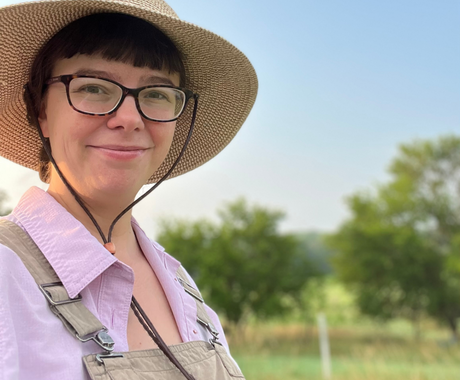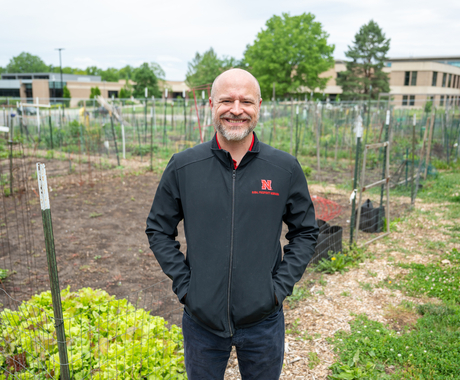
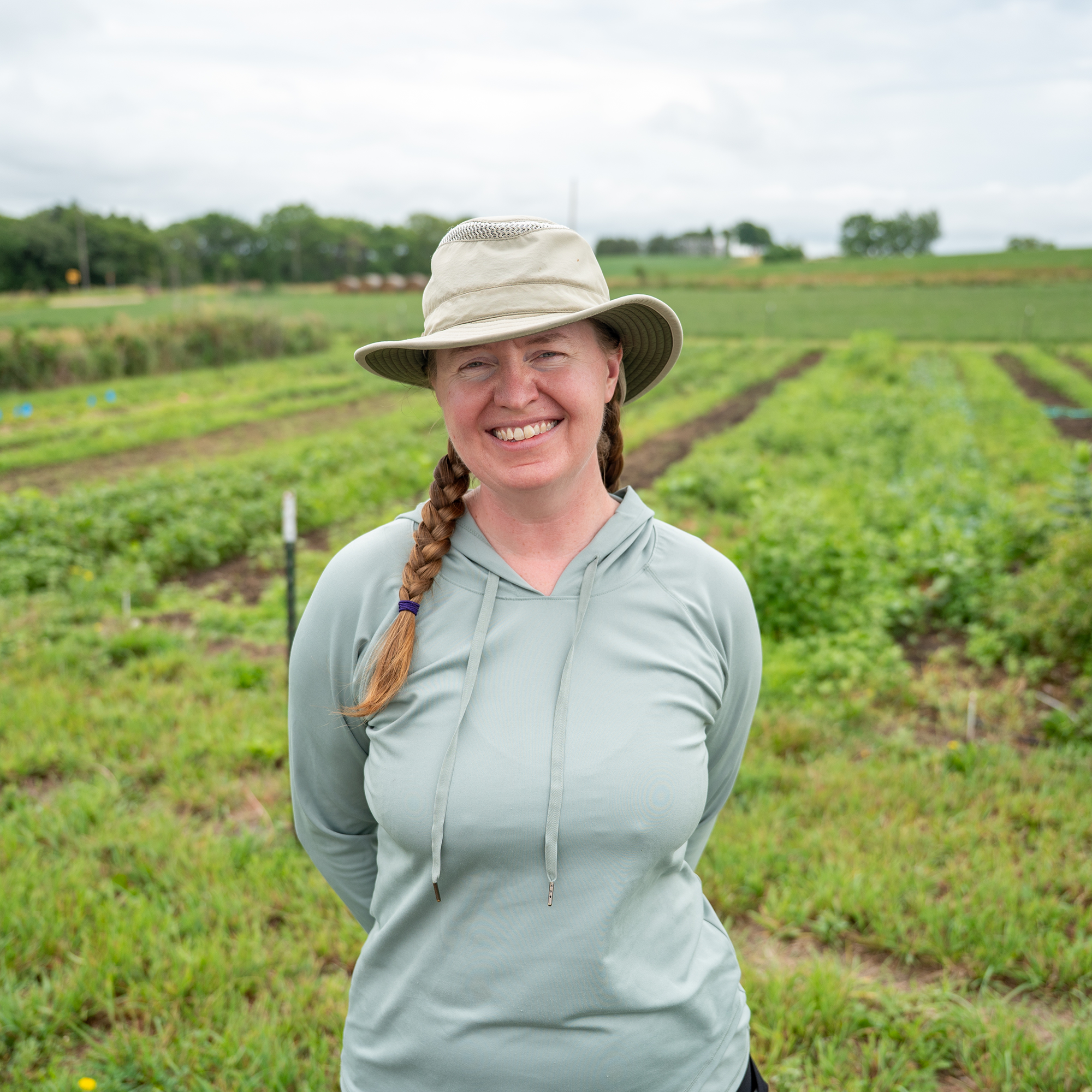
High school teachers Dené Oglesby and Paul Callahan jumped into agriculture without any experience, only the desire to branch out into something new that allowed them to care for the environment.
“Neither of us are from farming families so we truly started from zero,” said Dené. “As educators and commuters, we have had to choose single-season projects so far, but are looking forward to transitioning one of us at least to part time to focus more on growing our farm business within a couple of years.”
Farming started as a hobby for the pair, then they bought their farmstead near Ashland, Nebraska, in November 2015. Named after the black locust trees, wild blackberry bushes, and native prickly pear cacti found growing on the property, Thornwood, their 9-acre operation, sits at the top of a bluff overlooking Salt Creek.
The farmers practice regenerative agriculture, permaculture, and custom grazing. Dené is a trained herbalist and native plant/pollinator enthusiast who volunteers as a Nebraska Extension Master Gardener and works to incorporate native habitat everywhere she can.
Paul has apprenticed with a local rancher and is exploring silvopasture, the practice of integrating trees, forage, and grazing domesticated animals in a mutually beneficial way. If done properly, silvopastures can work as nature-based remedies to improve soil health, capture and store carbon dioxide, and reduce erosion.
Over the years, they have experimented with growing produce, herbs, native plants, and fungi. They have also tried raising rabbits, egg and meat chickens, ducks, geese, hogs, and grazing cows.
“Our love of produce and herbs comes from our experience abroad in France, where organic and pesticide-free produce is standard practice,” said Dené. “We are both French teachers and our passion for quality, local food is what motivates and inspires us.”
In an effort to explore everything the agricultural world has to offer, Dené and Paul are taking part in the Center for Rural Affairs Beginning Farmer Conservation Fellowship Program.
To be eligible for the fellowship, beginning farmers must be actively farming in Nebraska for fewer than 10 years. The program emphasizes a variety of conservation topics essential to farming such as cover cropping, rotational grazing, pollinator habitat, soil health, water conservation, topography, and climate mitigation strategies.
The program started in 2022 with eight farmers, plus mentors. The most recent cohort was chosen in January 2025 and will continue through August 2026.
Dené and Paul’s market crop staples are pears, tomatoes, squash, potatoes, and herbs. They would like to expand with more plants that can support soil health and remediation such as hazelnuts, aronia, currants, sunflowers, and edible fungi.
They sell directly to friends and family, although they hope to open an honor-system farm stand within the year to start direct farm-to-neighbor sales. Working with their fellowship mentor, Ali Yahnke of The Perennial Homestead, who runs her own farm stand, was the inspiration for their plan.
“We have greatly appreciated her insight on agriculture business practices, the design of a successful and productive market garden, and how to run a values-based enterprise,” Dené said. “[An honor-system farm stand] is ideal for us because we can have it open seasonally and it will work with our current jobs until one of us transitions to Thornwood more permanently. It will be a good way to slowly and sustainably grow our farm business.”
Dené’s dedication to native plants and habitats inspired her to start a native plants garden at Thornwood. For the first few years, she and Paul kept their eyes on what was already growing on their land, which is made up of sandy loam and clay soils.
“We worked to improve the soil via composting, spreading manure, and reducing mowing after years of the prior owner mowing every square inch like a lawn,” Dené said. “Goldenrod, violets, clover, hoary vervain, coneflower, milkweed, wood aster, nettles, coreopsis, rudbeckia, and more popped up to say hello! The native garden is an outgrowth of my love for nature and a meaningful part of how we weave the fabric of life at Thornwood.”
As part of the conservation fellowship, farmers design and implement a project on their own farm or land they are farming. They present their findings at a farm tour to their mentors, project partners, and other beginning farmers.
Dené and Paul's primary focus has been water management and erosion control, which they are achieving through a drip irrigation system to expand the native garden and decrease water use in their market garden.
“We want to scale up and need to wisely monitor these labor-intensive gardens, especially as we experience greater climate instability,” said Dené. “By investing in drip irrigation, we will have better native plant and seedling establishment, which is crucial.”
In a few years, the two hope to be able to welcome the community to stroll through their garden on a native sensory trail, complete with interpretation signage to help educate folks about native species. They also want to host seasonal events that incorporate the arts, like using plants for natural dyeing and basket/cordage weaving with natural materials.
Another process they’ve been working on is building a reactor to make biochar, which is charcoal produced from plant matter and stored in the soil. They also use compost to create their own potting soil for seedlings. Moving forward, Paul would like to learn more about pasturing on native grasses and Dené wants to dig deeper into supporting local mycology, the study of fungi.
“We are perpetual students of life,” she said. “I often forget how far we’ve come, but remember when I can read a plant or the soil and know what to do to support it and the other organisms who depend upon them..”
Because of the fellowship, Dené and Paul have a better understanding of both traditional and nontraditional agriculture. They’ve been educated about irrigation, the use of prescribed fire, and the ins and outs of managed grazing, and they’ve been connected to the Nebraska Sustainable Agriculture Society.
They’ve also been able to visit other farms and farmers to learn about their practices.
“It has been wonderful to get to know so many other people in Nebraska who are as passionate as we are about food, community, and the environment.”
“We have been full-time high school teachers and commuters the entire time we have been at Thornwood,” said Dené. “Being named a fellow felt like a recognition of all our prior experience and hard work.”
“Ten years from now, we hope Thornwood is a hub for good food, community, and learning.”
For more information, visit cfra.org/beginning-farmer-conservation-fellowship-program.
This material is based upon work supported by the U.S. Department of Agriculture (USDA), under agreement number NR243A750003C010.
Any opinions, findings, conclusions, or recommendations expressed in this publication are those of the author(s) and do not necessarily reflect the views of USDA. In addition, any reference to specific brands or types of products or services does not constitute or imply an endorsement by USDA for those products or services.
USDA is an equal opportunity provider, employer, and lender.