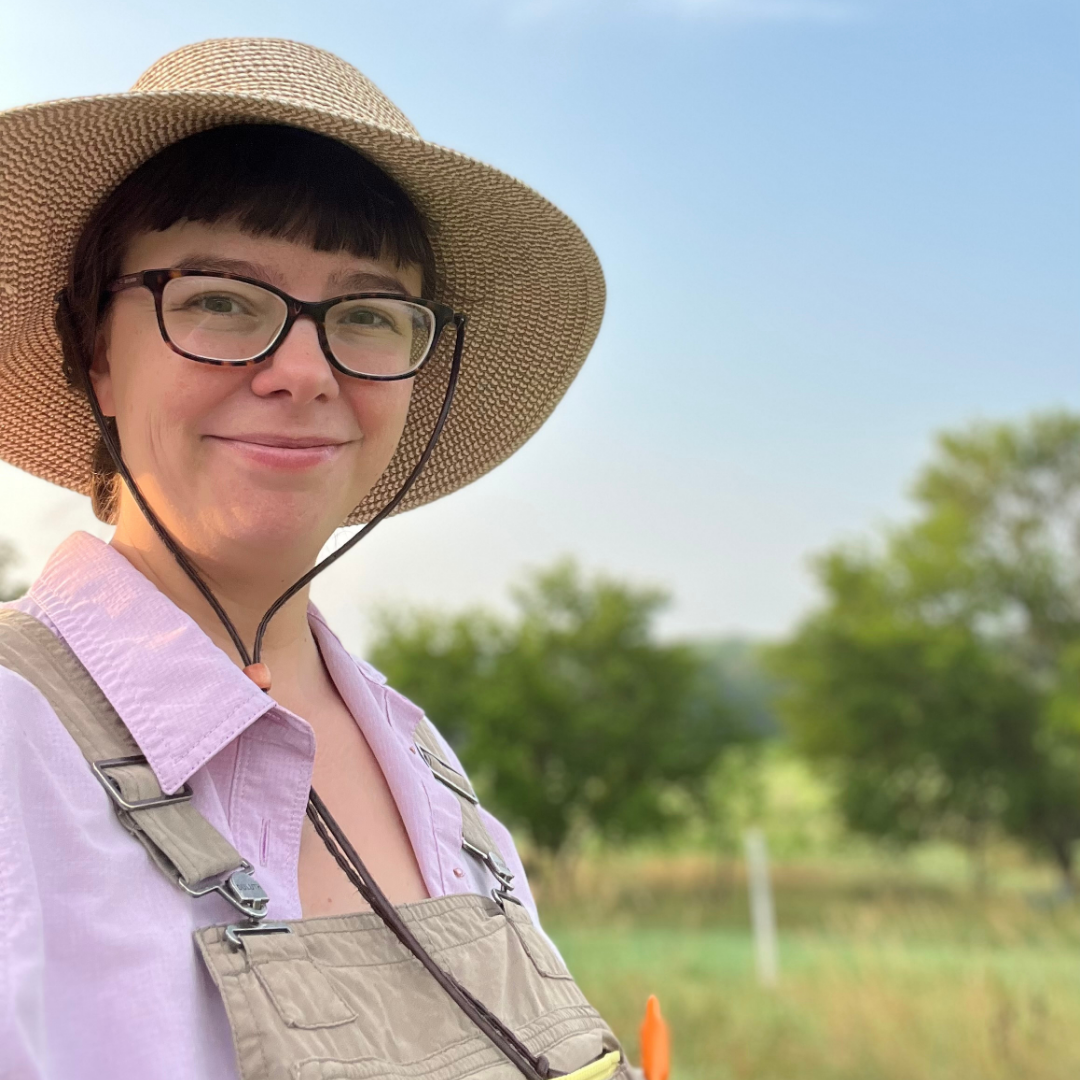
Skylar Falter was exposed to new information about the impact of industrial agriculture on both the environment and food systems while in college, and it made her see food and land in a whole new light.
Since then, she’s been on a mission to connect with the earth, and she began farming as a way to bring health and wellness to herself and to her community.
“I wanted to be part of a different way of growing, one that could offer fresh, nourishing food grown without synthetic chemicals or fertilizers,” Skylar said. “Beyond that, I was drawn to the physical and emotional experience of farming itself. I love being outside, working with my hands in the soil, watching things grow, and receiving the gifts of the earth.”
In 2015, Skylar and her partner started an urban vegetable farm in Lincoln. After moving to a rural area outside of Steinauer five years ago and taking some time off, Skylar wanted to start growing again. To get back into an agricultural mindset, she applied for the Center for Rural Affairs Beginning Farmer Conservation Fellowship Program.
To be eligible for the fellowship, participants must be actively farming in Nebraska for fewer than 10 years. The program emphasizes a variety of conservation topics essential to farming including cover cropping, rotational grazing, pollinator habitat, soil health, water conservation, topography, and climate mitigation strategies.
The program started in 2022 with eight farmers, plus mentors. The current cohort, including Skylar, was chosen in January 2025 and the fellows will graduate in late 2026. And, while Skylar considers herself more of a grower than a farmer, she’s taking full advantage of everything the fellowship has to offer.
“My goal is to learn more about conservation projects in rural areas, bring more diversity to the land, and give love to the earth,” she said. “I would love to design a creative way to bring more conservation to the land around me.”
Skylar and her family live on 840 acres of prairie in southeast Nebraska. Her partner helps manage the livestock operation for the landowners, and they both take care of the land near their home. They implement conservation practices including rotational grazing and intensive management grazing of their livestock to help restore the prairie ecosystem, and they use no-till in their garden and tree-planting endeavors.
“Because we live so remotely, the land feels deeply peaceful and quiet,” Skylar said. “Our homestead has been shaped by what we’ve learned over time. After years of growing annual vegetables, one of the first things my partner and I did when we arrived on this land was to plant perennials, knowing we were investing in the future. The result is a living mix of perennial trees, shrubs, mushrooms, and annual vegetables that grow together in relationship.”
Their perennials include Asian pears, persimmons, pawpaws, serviceberries, and gooseberries, with many of the trees still several years away from bearing fruit.
“On the south side of our house, a diverse vegetable garden thrives in the sun, and nearby, logs inoculated with shiitake mushrooms slowly do their work,” Skylar said. “It’s a place that feels intentional, calm, and always in the process of becoming. There’s a sense of patience and long-term care here.”
As part of the conservation fellowship, participants design and implement a project on their own farm or land they are farming. They present their findings at a farm tour to their mentors, project partners, and other beginning farmers.
Skylar’s project involves establishing an edible medicinal garden in an area near their homestead that is currently shaded and overrun with undesired plants.
“I picked this project because it brings joy and purpose to the land,” she said. “I plan to incorporate eight different native perennial plants along with an insectary strip of wildflowers. I will also establish a patch of serviceberry bushes. The goal is to provide floral blooms throughout the growing season and increase habitat for beneficial insects.”
The project will take many years to fully establish, Skylar said. She placed the garden close to her home to make ongoing care and maintenance easier.
“For this particular project, I am offering my time and creativity to help nurture a space on the land that needs more love,” she said. “Many people have little exposure to the wide variety of native plants that can thrive here, and I want to help change that. By welcoming people of all ages into the garden, I hope they can build relationships with these plants. Through these shared experiences, the garden becomes a place of beauty, learning, and community.”
Working with a mentor has been beneficial for Skylar as she moves forward with her project. The guidance has allowed her to build a meaningful relationship that she can lean on for support well after the fellowship ends.
“I really appreciate that this program emphasizes mentorship and accountability,” Skylar said. “My mentor provides valuable knowledge and, just as importantly, her encouragement motivates me to keep moving forward.”
Although the cultivated area closest to their home is less than an acre, living on this land also means caring for, and sometimes propagating, plants across the surrounding prairie. And, while not all of that land is actively farmed, Skylar sees it as part of her responsibility to observe, steward, and support its health.
“Sustainability, to me, is about living in balance with all life,” she said. “When we tend the land with care, we are also tending our relationships with each other and the ecosystems that sustain us.”
The areas of land that do have crops are loaded with fruits, native plants, and vegetables, as Skylar wants to offer her children the gift of fresh food and a way to develop a relationship with the earth.
“Gardening is something I’ve returned to with renewed purpose, not just as a way to feed our family, but as a way to teach care, patience, and reciprocity,” Skylar said. “I want my children to learn that gardening isn’t only about vegetables in neat rows—it also includes tending and honoring wild foods like serviceberry, gooseberry, nettles, and more.”
Being part of the Beginning Farmer Conservation Fellowship Program has allowed Skylar opportunities to do what she’s most passionate about: tend the land with care and consideration, and pass on that knowledge to others.
“This program has shown me that the everyday work of nurturing the earth and building community matters and can have a lasting impact,” Skylar said. “I have been deeply grateful for the farming community in Nebraska, which has been incredibly warm and welcoming. That sense of connection, both to the land and to people, continues to be a powerful source of meaning for me.”
For more information, visit cfra.org/beginning-farmer-conservation-fellowship-program.
This material is based upon work supported by the U.S. Department of Agriculture (USDA), under agreement number NR243A750003C010.
Any opinions, findings, conclusions, or recommendations expressed in this publication are those of the author(s) and do not necessarily reflect the views of USDA. In addition, any reference to specific brands or types of products or services does not constitute or imply an endorsement by USDA for those products or services.
USDA is an equal opportunity provider, employer, and lender.