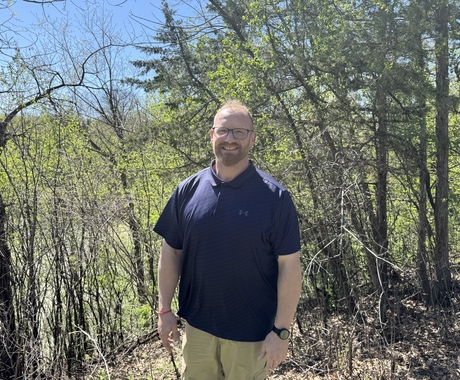

When Tony Vargas, who served in the Nebraska legislature from 2017 to 2025, talks about public service, his approach to lawmaking and governance comes through clearly.
“It doesn’t matter what your political affiliation is, where you come from, urban or rural, everything in between, your race, your ethnicity, your religion, or your background… we’re supposed to try to make it easier for you to share your voice and opinions to shape the work that [public servants] do,” he said.
The Center for Rural Affairs was proud to work with Tony throughout his tenure in the Legislature, and to present him with the 2024 George Norris Policymaker Award on Sept. 21 during Welcome Fest, hosted by the Center for Immigrant and Refugee Advancement and surrounded by food trucks and emerging entrepreneurs. This award is given to a policymaker who employs bipartisanship, compromise, and consensus to improve policy outcomes for family farms and rural communities.
Following are three ways the Center’s work with Tony resulted in positive changes.
Making life easier for food truck owners
When Tony was elected in 2017, he realized a lot of laws that dictated food truck owners’ work were antiquated and difficult to navigate.
Whether operating in urban or rural settings, many food trucks in Nebraska are also small businesses. They faced issues across the state, from regulatory inspections, licensing permits, and fees, to knowledge and infrastructure.
“Entrepreneurs were trying to meet a community need and support themselves and their family,” Tony said. “[They were trying] to employ individuals, and to honestly be the cultural bedrock of a community in an area. It was frustrating that we were making it harder for these people when it is already difficult to navigate being a small business owner and operator of a food truck business. So I decided to work on this legislation.”
He turned to the Center for Rural Affairs, along with other partners, to pass food truck legislation in 2023 that helped simplify the bureaucracy around operating the trucks in Nebraska.
“Having a nonprofit partner that understood and was connected to these small businesses and had relationships with them meant that we had somebody that was an advocate,” Tony said. “[We were] able to harness their voices for good, to inform legislation that affects their livelihood.”
The Center’s Policymaker award highlights that partnership.
“This award is a recognition of the work that my legislative team has done and is a recognition of what it looks like to create strong collaborations with other organizations,” he said.
The senator worked on the food truck legislation for five of the eight years he served in the Legislature.
“It took us years to get to this place, it truly and truly did,” Tony said. “So it was really encouraging to have a partner like [the Center]. And really encouraging that we got to get over the finish line. And there’s still more work to be done.”
Increasing accessibility in the Legislature
In 2022, Tony made history when he was a part of the first-ever Q&A in Spanish between a lawmaker and a citizen giving testimony in the Nebraska Legislature. On one end of the exchange was Tony, and on the other was a loan client of The Center, bakery owner Ana Gonzalez of Grand Island.
“Having business owners communicating in Spanish and having individuals that are testifying and speaking in Spanish was one of the really encouraging and historic moments for the
Legislature,” Tony said. “Because it’s reminding us that we are way more diverse than we let on.”
He added the Legislature is “meant to be and should be accessible to all as much as humanly possible.”
“That [day] was really encouraging and for me, as the son of Latino immigrants, and for my parents… it made me feel really good about the evolution of where we are as one small step,” Tony said.
He hopes speaking Spanish in the Legislature will occur more often.
“We can do more to make it accessible to people of all different languages and religions and spaces,” Tony said.
Protecting workers in the meatpacking industry
During COVID-19, meatpacking workers were essential workers being exposed to the virus on the job. Tony introduced legislation to address worker safety provisions and had the first hearing across the country on meatpacking worker safety at that time.
“It took a lot of firsts,” he said. “This was really critical work on behalf of a lot of communities, in particular, more rural or micropolitan communities that have high immigrant populations, refugee populations, and meat packing, food processing companies, and plants.”
He listened to workers and their families across the state.
“We had a public conversation about the real issues and shortcomings in the industry, both identifying industry standards that were [not being reached] and some companies that were doing more than they should have,” Tony said. "This is the reason why we do this work.”
Another reason he worked so hard on this particular bill is because he lost his father to COVID-19.
“I was particularly connected to this issue. My dad was working on the frontlines as a union worker and I didn’t want to see anyone else go through what me and my family did,” Tony said. “This was about being pragmatic and about being responsive to the needs of our communities. And, also being responsive to the needs of employers in greater Nebraska.”
While the meatpacking worker legislation did not pass, Tony said many were able to leverage better sick leave and conditions because of the work and because of stories that were brought up in the media.
“And, it wouldn’t have happened unless we had the collaboration and the partnership with the Center for Rural Affairs and others, so it means a lot,” he said. “It also means a lot because effectiveness matters a tremendous amount to me. I loved working in the Legislature because I want to solve problems on behalf of those [whose] voices can be hidden or muffled.”
Tony said both the food truck and the meatpacking worker legislation are good examples of bills brought forward in response to everyday people’s needs.
“These instances of legislation, it just reminds me that we don’t like politicians just to argue,” he said. “We like politicians to solve issues that are urgent, that are responsive to the needs of our communities. Receiving the award reminds me that we did just that. We were actually effective in doing good on behalf of Nebraskans.”
While Tony represented the 7th District of Nebraska, which covers all of downtown Omaha and much of southeastern Omaha, he helped pass more than 70 bills focused on health care, job creation, affordable housing, and consumer protections, focusing on creating opportunities for all Nebraskans through collaboration. His public service career continues as the executive director of Square One, a national nonprofit founded to change the way we lead in politics.
“As the Center for Rural Affairs has been a partner on different pieces of legislation over the years, I thank the people and the communities that you support,” Tony said. “The way we get really good legislation moving forward, the way we find compromise, is having partners at the table like yourselves. It has really been wonderful working together.”
“We appreciate Tony’s support and partnership,” said Sandra Renner, Center chief of staff, who presented the award to the former senator at Welcome Fest. “May you go on and continue to make history.”