
By Madeline Faber, former staff member
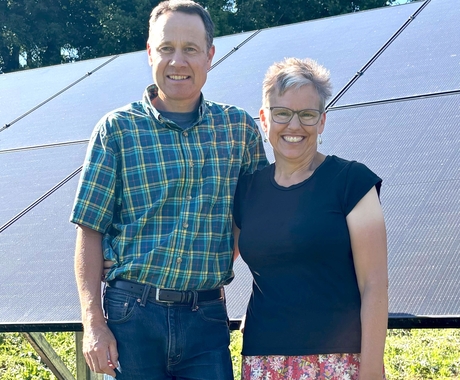
Ten years ago, Omaha Public Power District Board member Eric Williams took the leap to power his home with solar energy.
He has since significantly upgraded his setup with a Sol-Ark 15 kilowatt (kW) inverter and 9.6 kWh of Lithion HomeGrid batteries. The inverter manages the flow of energy between his solar panels, battery, and home, while the battery stores excess energy for use during outages or peak demand times.
"The ultimate goal has always been to achieve a resilient, electrified home while keeping costs reasonable," Eric said.
The upgrade enables Eric’s Omaha area home to operate as a “nano grid,” which is a small-scale energy system capable of operating independently from the main utility grid. The system allows for whole-home electrification even during a grid outage. It stores excess power during off-peak times and uses it during peak demand, a feature that Eric appreciates for both its cost-savings and responsiveness.
Thanks to his enhanced system, Eric’s home can shift seamlessly to battery power in the event of a grid failure.
“During a recent outage, the shift to battery power was so quick that our clocks didn’t even reset,” he said.
Last fall, Eric experimented with going entirely off-grid, running his home without utility power for 99 hours. While his 9.6 kWh battery couldn’t handle the continuous load of air conditioning during the early September heat, it reliably powered essential systems like refrigeration, freezing, and Wi-Fi. By temporarily switching off non-essential devices, Eric ensured critical functions remained operational. All in all, he considers the experiment a valuable learning experience.
Setting up a solar and battery system has been a journey for Eric, marked by a learning curve and a scarcity of knowledgeable contractors.
“Finding someone who understands systems like this was challenging,” he said.
As an Omaha Public Power District Board member, Eric sees significant potential for residential solar and battery systems to support Nebraska’s clean energy goals.
"While utility-scale projects dominate our clean energy mix, small residential systems like mine have real value," he said.
These systems are particularly important in rural areas, where they can provide greater energy independence and resiliency. Rural communities often face challenges such as aging or limited infrastructure and are more vulnerable to outages caused by extreme weather events.
Distributed Energy Resources (DERs) like residential solar and batteries can help stabilize the grid, reduce reliance on distant power sources, and ensure more reliable energy access during emergencies. Eric advocates for rate structures and policies that encourage DERs, especially in areas where grid demand is high or infrastructure improvements are most needed.
Sharing his experiences has always been central to Eric's approach, as he hopes his example will inspire others to consider renewable energy at home. He also believes public awareness and incentives are key to expanding residential solar and battery systems.
As for his own system, Eric plans to expand his solar capacity by an additional 3 kW and add more insulation to his home for greater efficiency. He doesn’t intend to go entirely off-grid, preferring instead to maintain a balanced connection with the utility.
"The blend of grid and home solar is, for me, the ideal setup," he said.