The Center for Rural Affairs now offers community and business solar loans as well as personal solar loans.
Community and business solar loans are for construction, to enable investment tax credit safe harboring, and for working capital for qualified solar businesses. These loans are for $100,000 to $3 million and are targeted to serve local businesses, schools, and municipal buildings.
Personal loans are for construction loans for solar arrays up to 99 kW in size for projects located in Nebraska, with limited ability to consider well-qualified projects elsewhere. Personal loans will be awarded in an amount between $5,000 to $250,000.
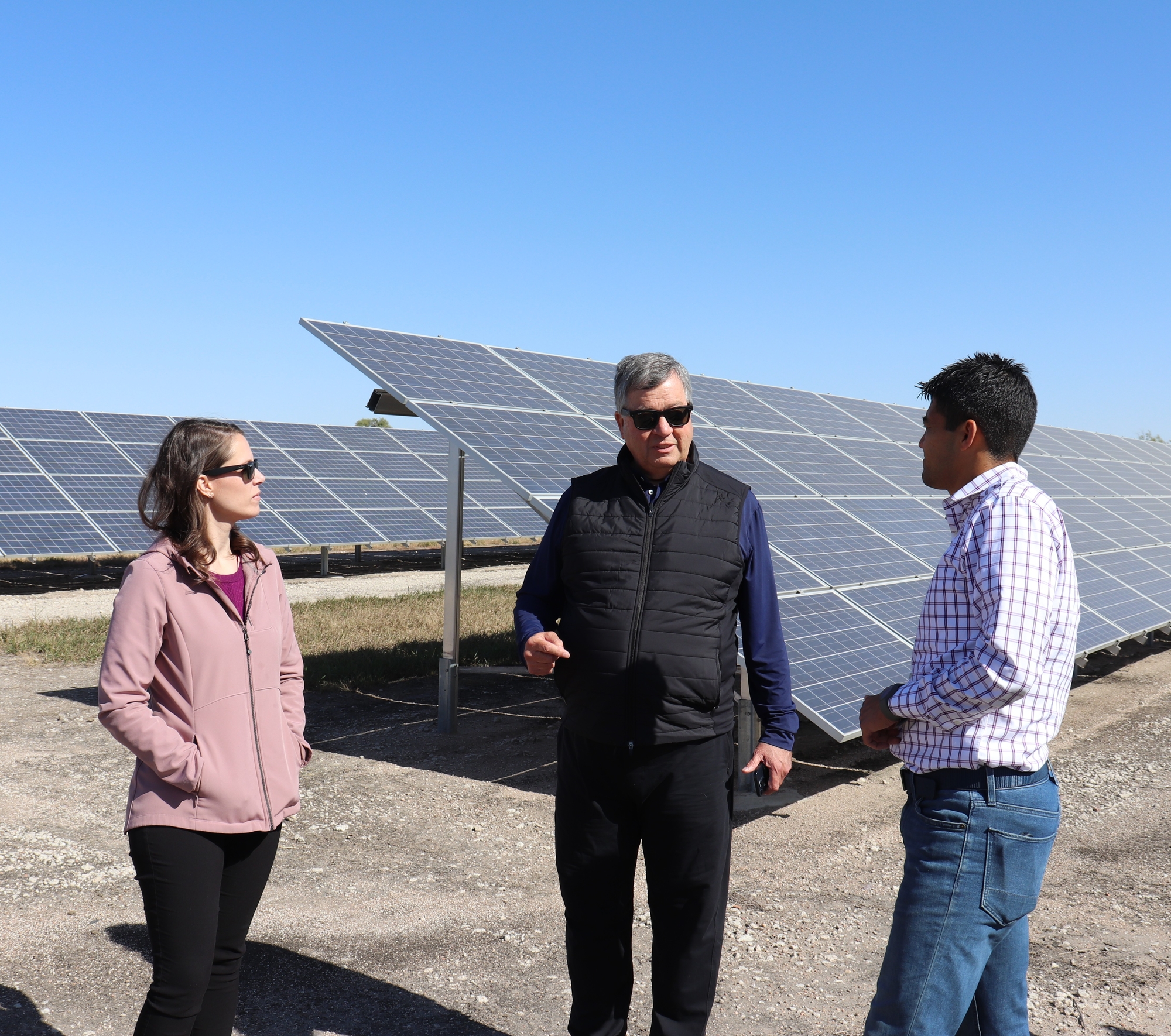
“By providing essential construction and working capital, we want to empower local contractors and entrepreneurs to own and build these systems themselves, cultivating a Nebraska [solar] workforce,” said Daniel Padilla, the Center’s Director of Climate Lending.
Alongside the loans, Center staff is providing pre-development and feasibility support by conducting site assessments and system sizing, while coordinating with local utilities to ensure a successful grid connection.
“I think of the Center's work and our loan products as a critical backstop to ensure rural and Tribal communities in Nebraska are not left behind,” Daniel said. “We need to ensure low-to-moderate income households and small rural businesses are not priced out of the energy transition.”
In Nebraska and across the country, solar energy is needed for both reliability and load growth.
For example, in the Cornhusker State, today data centers account for almost 25% of generation, while in 2018, it was 1%. By 2035, data centers are projected to account for 41% of generation.
“I think utilities are being pragmatic about solar,” Daniel said. “With electric utilities implementing rate hikes, solar is a proven solution and a hedge against rising electric rates. This is making smaller cities and villages consider small community solar projects while making residential solar more attractive.”
This aligns with the Center’s mission of cultivating strong communities rooted in social and economic justice, environmental stewardship, and opportunity for all.
“The Center wants to be part of this transformation by helping our cities and families generate their own power and lock in energy savings for decades, making the communities we live in more resilient,” Daniel said.
To learn more about solar lending at the Center, visit cfra.org/SolarLoans.