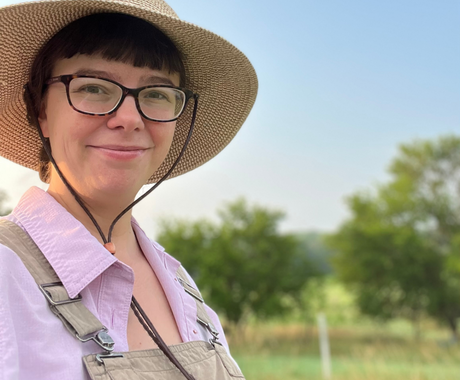

Five miles north of Pierce, Nebraska, sits the 80-acre farm where Denice Hansen was raised. After spending her childhood working cow/calf pairs, feeder cattle, and growing row crops and garden vegetables, she needed a break from rural life.
City living called to Denice, and she and her husband ended up in Omaha. When her husband developed an interest in agriculture, leaving the metro area to go back home to farm wasn't Denice’s first choice. However, now that she’s been back for awhile, Denice is glad to have made the decision to return to her roots.
Their move also gave Denice’s dad the chance to gradually step back from farm work. Along with her husband, Denice has taken on more tasks and learned how challenging farm life can be.
“In the past 10 years, I've watched as the farming world has drastically changed,” she said. “Small farming is becoming harder and harder, with more and more risk and less and less profitability. Traditional farmers are pigeonholed by what we can make, so including sustainable practices is not only financially beneficial by reducing our input costs, but it also returns nutrients back to our soil, which is the foundation of everything we do.”
This realization impressed upon Denice the importance of making changes to keep things going, and she has been looking for ways to diversify their farm.
“We raise some hobby cattle (minis) as one option,” she said. “My husband's workload is pretty great, so I wanted something I could experiment with myself. I stumbled upon mushrooms and really liked that it was something I could grow in the ‘off season’ indoors, had a very quick turnaround, and great health benefits as well as being able to use the spent substrate in compost.”
Denice’s interest in mushrooms grew to the point where she needed more time and money to keep up with her desire to raise this unique crop. She heard about the Center for Rural Affairs Beginning Farmer Conservation Fellowship Program during a conference and decided to apply.
To be eligible for the fellowship, beginning farmers must be actively farming in Nebraska for less than 10 years. The program emphasizes a variety of conservation topics essential to farming such as cover cropping, rotational grazing, pollinator habitat, soil health, water conservation, topography, and climate mitigation strategies.
“The program is able to dedicate funds that allow me to devote time to learning more about not only mushrooms, but many other practices that I can bring back to our operation,” said Denice. “I wanted to be able to take the next step and this program has given me the ability to do so.”
As part of the conservation fellowship, farmers design and implement a project on their own farm or land they are farming. They present their findings at a farm tour to their mentors, project partners, and other beginning farmers.
Denice’s project involves purchasing a freeze dryer to increase the lifespan of her harvested mushrooms. The device will allow her to use them in teas and tinctures rather than only being able to use the mushrooms when they are fresh.
“Lots of people say they are interested in fresh mushrooms, but after six months of growing them and basically giving them out, I haven't had the return I wanted,” Denice said. “I'm not able to do many farmers markets and put in that time, so I'd like to try making teas and tinctures that can be sold year round online, or in local stores.”
While the project is still in the works, Denice’s dedication to the cause drives her forward. She and her farmer mentor email back and forth about ideas and remain enthusiastic about her project’s prospects.
“If I'm able to purchase the freeze dryer, it will let me test a new market,” she said “Then, I can play with different products and hopefully find a model that works for me long-term.”
Until then, Denice continues to improve other areas of the farm. She started a compost system and implemented no-till in her garden this season, while her husband planted a cover crop in their cornfield. They also raise cow/calf pairs, and have land reserved for row crops where they grow corn and beans.
“Both of us would love to do more, but it's hard to take the risks and put in the time it takes to convert to organic when the farm is barely making it as is,” Denice said. “It's hard to just switch everything you're doing at once, so I'm hoping we can do some smaller test plots and build from there.”
Building community is crucial for Denice, too. With a professional background in the arts, she loves to connect, collaborate, and create with the people around her.
“Farming is an island,” she said. “You work all day, every day by yourself and it can be easy to think no one understands you. When, in reality, the likelihood of your neighbor or someone close to you going through and feeling the same way is pretty high. We just need to connect with each other and help each other.”
If she could do it all over again, Denice would tell herself to be patient and stay focused, as many of her ideas take time and patience to fully come to fruition.
“So much of farming is sowing the seeds and waiting for them to grow,” she said. “In the meantime, I start another project and sometimes forget about the first one. Try one project at a time and really put your full self into it.”
While she tries to heed her own advice, Denice doesn’t stop thinking about the future of the farm. Eventually, she’d like to grow Christmas trees to sell, expand her pumpkin patch, start a medicinal garden for teas and tinctures, and more. She’s grateful to have learned so much during the fellowship to help her define and work toward her goals.
“It was really an honor, and I was very surprised to be chosen,” Denice said. “I’ll keep farming because I want to save it—I want nothing more than to preserve this way of life.”
For more information, visit cfra.org/beginning-farmer-conservation-fellowship-program.
This material is based upon work supported by the U.S. Department of Agriculture (USDA), under agreement number NR243A750003C010.
Any opinions, findings, conclusions, or recommendations expressed in this publication are those of the author(s) and do not necessarily reflect the views of USDA. In addition, any reference to specific brands or types of products or services does not constitute or imply an endorsement by USDA for those products or services.
USDA is an equal opportunity provider, employer, and lender.