
Angelyn Wang contributed to this story.
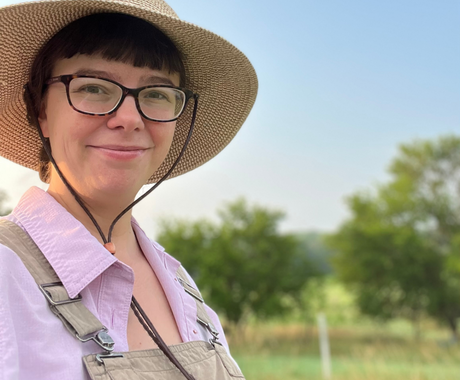
Angela Mueller credits her grandfather for nurturing her passion for growing local food. Raised in south central Nebraska, she was inspired by his innovative approach to gardening, which was rooted in traditional methods.
Today, Angela follows her grandfather’s example as she runs her own operation, Wood Barn Farm, Flowers and Farm Goods, outside of Plattsmouth, Nebraska. She acquired the land in 2020 and grows cut flowers as a specialty crop. She believes cut flowers to be a wise choice for the market in her area and has found a great network of local flower growers, which she finds encouraging.
“My grandfather was an inventor; he was always dabbling in how to improve his ‘greenhouse,’ or experimenting with hydroponics using found materials,” said Angela. “I have shared with my own children a phrase that comes to mind when I think of my grandfather, ‘necessity is the mother of invention.’ As in, inspiration comes from need; creating what we need from what we already have.”
Wood Barn Farm sits on 18 acres of rolling hills and features a natural spring. Native wildlife and tall grasses thrive there, and Angela nurtures the native flowering plants on the property, as well as raising chickens and bees. Upon purchasing the land, she began planting fruit trees and bushes. This year, she planted perennial flowering plants.
Angela has an educational background in art and early childhood education, though her experiences have been more entrepreneurial. Most recently, she owned and operated a brick-and-mortar store in the historic district of downtown Plattsmouth, where she offered many locally sourced products. She has since sold the store to focus on her farm.
“In addition to being inspired by my grandfather, I genuinely love being in the garden,” Angela said. “I’m amazed every time I plant a tiny seed and it produces so much bounty and so much beauty. I have enjoyed growing food for our own consumption (and some to share) since I was very young. My grandfather grew a lot of our food when I was growing up and held some livestock such as chickens and rabbits for eggs and meat. I learned from him and was inspired to continue this for my family.”
Her relationship with food production has grown over time from gardening to managing and participating in farmers markets, as well as hosting workshops. The connections she’s made from those experiences led her to apply for the Center for Rural Affairs Beginning Farmer Conservation Fellowship.
The program began in 2022 with eight individuals, plus mentors. The most recent cohort began in spring 2024 with eight beginning farmers, including Angela.
Fellows explore many conservation topics essential to farming, including cover cropping, rotational grazing, pollinator habitat, soil health, water conservation, topography, climate mitigation strategies, and more.
“I feel very encouraged by being around those who are encountering similar experiences, both positive and negative,” Angela said. “Also, I would describe myself as a lifelong learner, and I would consider the fellowship to be an excellent way to immerse myself in the subject of conservation and farming.”
Over the years, Angela has put in a garden whenever and wherever she could find a spot. Even if she only had room for a few plants, she’d always grow tomatoes and herbs, and has had good luck planting in pots.
She’s now in a situation where she can plant as much as she wants and have room to grow.
“We know we have the time in this space to benefit from perennials and fruit trees and bushes,” Angela said. “I once read that planting fruit trees that you know will not produce for years is a sign of hope for the future.”
As part of the program, conservation fellows design and implement a project on their own farms or land they are farming. They present their findings at a farm tour to their mentors, project partners, and other beginning farmers.
Angela’s project focuses on soil health. Testing the soil in multiple areas on her farm will determine deficiencies in the soil.
“We will collect data with continued soil testing and using visual cues such as earthworm presence and obvious organic improvement,” she said. “Next steps will be introducing a cover crop for pathways and seasonal rest periods. We will also use organic mulch to suppress weeds and introduce further organic material into the soil.”
After that, Angela aims to reduce and/or eliminate tillage of the soil and use a broadfork to decompress it when necessary. Pollinator strips will be planted to encourage pollinators.
“By improving the soil, we will increase the productivity of our farm,” Angela said. “By improving the soil from clay to an organic rich soil, we will create a more workable soil going forward with improved results each additional year.”
The purchase and application of organic compost and mulch, as well as beginning a compost heap on her farm to create her own compost, will help Angela sustain her project long into the future.
“We have made great connections with agencies that can provide information and resources,” she said. “We hope to create relationships with local businesses, for example someone who has a wood chip by-product to share. We also plan to expand the original plot where we are doing the soil improvement. From soil health, to climate, pollinators, and prairie plants, I’ve learned so many things from the fellowship.”
For more information about the Beginning Farmer Conservation Fellowship, and to meet our other fellows, visit cfra.org/beginning-farmer-conservation-fellowship-program.
The Beginning Farmer Conservation Fellowship is a program of the USDA-NRCS under agreement number NR243A750003C010 Conservation Outreach: Equity Conservation Cooperative Agreements.