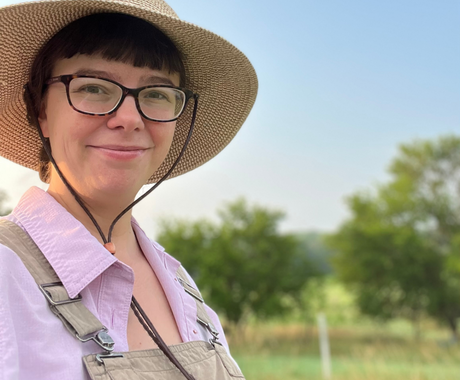

Lainey Johnson didn’t grow up farming, but she spent her childhood watching her mom bring plants to life in their family's garden. That inspired Lainey to test out her own skills, and she and her husband, Andy, started farming in fall 2017.
“My mom was an avid gardener and had a small greenhouse as well,” Lainey said. “As a teenager, I would act like I did not enjoy helping her, but I really did love it. My husband and I started our farm wanting to provide our community with beautiful and quality local products.”
Their small operation, Bright Hope Family Farm, is just outside of Firth, Nebraska. The couple began by growing vegetables. In 2020, Andy put in a small cut-flower garden, which changed everything.
“It turned out to be an excellent year to be able to share more beauty with our community,” Lainey said. “It was wonderful to see how much joy the flowers brought people. Each year since, we’ve added more and more flowers, and three years ago we committed to growing 100% flowers.”
They sell their quality flowers at several florist shops in the Lincoln and Omaha areas and to designers, markets, and the general public, as well as provide garden and small-scale farming consultations.
Lainey is a big proponent of environmental stewardship and strives to care for the land the best she can. To broaden her knowledge and abilities, she applied for and was accepted into the Center for Rural Affairs Beginning Farmer Conservation Fellowship Program.
To be eligible, beginning farmers must be actively farming in Nebraska for fewer than 10 years. The fellowship emphasizes a variety of conservation topics essential to farming such as cover cropping, rotational grazing, pollinator habitat, soil health, water conservation, topography, and climate mitigation strategies. The program started in 2022 with eight farmers, plus mentors. The current cohort was chosen in January 2025 and will continue through August 2026.
“It seemed like an excellent educational opportunity to add more production to our farm through sustainability and perennials,” Lainey said.
Bright Hope Family Farm has about an acre in production, including hoop houses to extend the growing season. Lainey uses soil health as the foundation for the farm through no-till practices, cover cropping, soil testing, and building a living soil.
As part of the fellowship, farmers design and implement a project on their own farm or on land they are farming. They present their findings to their mentors, project partners, and other beginning farmers.
For her project, Lainey is redoing the farm’s perennial flower and foliage area.
“Perennials are a great way to add unique products for our customers while providing habitat for birds and beneficial insects, improving our soil health, creating wind breaks, and not having to plant every crop each year,” she said.
Progress has been slow this fall, as Lainey has been fighting off an illness, but she and Andy have prepped the area for spring planting and are looking forward to picking out the varieties of perennials to add to the space. They plan to add more perennials each year to ensure the project is long-running.
In addition, Lainey has had the opportunity to work with a mentor who owns a cut-flower business in Nebraska.
“She has been an incredible wealth of knowledge,” Lainey said. “You can read about different practices or new flower varieties, but learning from someone in our area with years of experience is priceless.”
As a fellow, Lainey has gained new perspectives by working with sustainable farmers in her area. Together, they are improving their farms by learning from each other and their mentors.
“It has also given us an opportunity to educate our community, employees, and customers more about sustainability through our project,” Lainey said. “It’s great to be a part of a group of people with the same goals of sustainability and improving our environment.”
For more information, visit cfra.org/beginning-farmer-conservation-fellowship-program.
This material is based upon work supported by the U.S. Department of Agriculture, under agreement number NR243A750003C010.
Any opinions, findings, conclusions, or recommendations expressed in this publication are those of the author(s) and do not necessarily reflect the views of the U.S. Department of Agriculture. In addition, any reference to specific brands or types of products or services does not constitute or imply an endorsement by the U.S. Department of Agriculture for those products or services.
USDA is an equal opportunity provider, employer, and lender.