
Minnesota native Nolan Lemna has always thought of himself as a city kid with a farmer’s heart. Even though both of his parents left their family farms to pursue other opportunities, Nolan felt drawn to explore his agricultural ancestry.
“I always wanted to raise livestock and was finally able to join 4-H in middle school,” he said. “I was given the opportunity to raise pigs, goats, and a plethora of poultry all the way through high school. Eventually, I convinced my folks to allow me to build some poultry pens in town and before I knew it, I was hatching ducks and pheasants in my bedroom.”
These first few experiences with agriculture laid the framework for Nolan’s future in farming. He currently works alongside three other beginning farmers at Morning Sky Acres, near Valparaiso, Nebraska, as well as raises a large amount of plant starts and produce at this home in Lincoln.
In addition to tending the land, Nolan loves working with livestock. When he joined Morning Sky Acres, cattle were already a big part of the picture, so he was a natural fit. Nolan is also directly involved with three-fourths of an acre of produce production and 80 acres of pasture. On the farm, he also helps maintain a wetland project, traditional row crop plots, and Conservation Reserve Program (CRP) ground.
“I chose to start pursuing farming as a profession when I was 21, when I had finally tasted a farm fresh, organic tomato,” Nolan said. “My life was changed when I learned that vegetables from the grocery store and from the farmers markets are vastly different—from taste to nutrition density to how they were raised.”
Nolan believes excellent food—whether it is free-range eggs, pasture beef, or organic vegetables—is the best medicine.
“Everyone should have access to these products and I am committed to making that happen,” he said. “Although I am not a full-time farmer yet, each year I get closer and closer to accomplishing it.”
One way Nolan is working toward that goal has been taking part in the Center for Rural Affairs Beginning Farmer Conservation Fellowship Program.
To be eligible for the fellowship, beginning farmers must be actively farming in Nebraska for less than 10 years. The program emphasizes a variety of conservation topics essential to farming such as cover cropping, rotational grazing, pollinator habitat, soil health, water conservation, topography, and climate mitigation strategies.
The program started in 2022 with eight farmers, plus mentors. The current cohort, including Nolan, was chosen in January 2025 and the Fellows will graduate in late 2026.
“As I have tried to build my own farming operation, I figured the Center would have programs to assist me—and I stumbled upon this specific one,” Nolan said. “I love learning and the opportunity to attend classes, workshops, conferences, etc. through this program enticed me to join.”
Nolan describes his operation, Morning Sky Acres, as sustainably driven and loaded with potential. The diversified farm consists of traditional row crops, cattle, and produce production. Each year, Nolan adds more produce plots and plants to continue growing that branch of the farm.
He also grows a variety of native perennials, ornamental annuals, veggie starts, and indoor plants that are sold at farmers markets in Lincoln, along with their beef and produce. The beef is often delivered to local communities or shipped, recently as far as Maine.
Nolan says all four farmers at Morning Sky Acres bring unique experiences and perspectives to the operation.
“We are all beginning our journey of farming and doing our part to build an operation that can sustain our families and support our communities well into the future,” he said. “We always prioritize the land we are trusted with. Whether it is manually pulling out noxious weeds in the pasture, planting pollinator friendly plants in each available area, or planting cover crops to improve the soil health, sustainability is a huge driving force behind it all.”
As part of the conservation fellowship, farmers design and implement a project on their own farm or land they are farming. They present their findings at a farm tour to their mentors, project partners, and other beginning farmers.
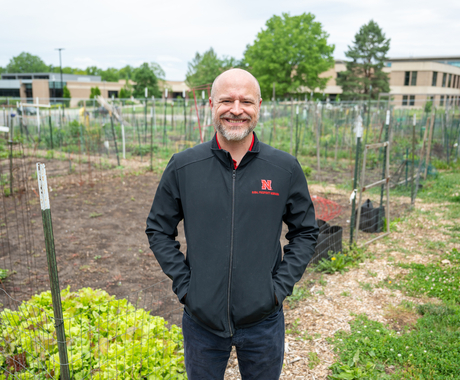
The main focus for Nolan's project is to maximize production on his urban plot by adding a drip irrigation system, rainwater collection systems, and low-tunnels for season extension.
Hands-on crops such as lettuces, peas, beans, herbs, are grown in town, and Nolan wants to maximize that space to its fullest potential for both sustainable practices and food production.
The farmer will also be expanding his seed-growing setup with a new rack system and cold-frames to increase the amount of native plant starts he’s able to produce. He plans to meet with his mentor this year in hopes of gaining even more knowledge and advice as he works toward his agricultural goals.
For Nolan, the farm isn’t just about the cattle or produce; it’s the people, too. During the past year, he had the opportunity to open up his produce plots to neighbors and friends.
“It has been a blessing to watch people encounter delicious food, just as I did, and leave convinced to support local, regenerative farmers,” he said. “It has also been a huge blessing to get to know each and every one of our customers at markets. The relationships built make the heat, humidity, and long days worth it! Meals have the power to connect us, and it is a privilege to be a part of that.”
At the farmers markets, Nolan makes sure to pass along the knowledge he’s gained since diving into farming.
“I do not think most folks who shop at the grocery store are aware of sustainable agriculture producers and what we do for the environment and local food systems,” he said. “Building a community of both industry stakeholders, and people excited about good, sustainable food, is very important to me.”
Through the conservation fellowship, Nolan has been able to build on the ideas and practices he’s already established and has high hopes for the future of his farm.
“I am honored and privileged to have been selected for this fellowship and am blessed to have had it intertwined with the foundation of my farming story,” he said. “My customers at the market are invested in the work that we do, and seem keen on finding sustainably raised food. I have been amazed by the support of our community members and know that between friends, family, and customers, the demand for veggies remains high!”
For more information, visit cfra.org/beginning-farmer-conservation-fellowship-program.
This material is based upon work supported by the U.S. Department of Agriculture (USDA), under agreement number NR243A750003C010.
Any opinions, findings, conclusions, or recommendations expressed in this publication are those of the author(s) and do not necessarily reflect the views of USDA. In addition, any reference to specific brands or types of products or services does not constitute or imply an endorsement by USDA for those products or services.
USDA is an equal opportunity provider, employer, and lender.