Policy program staff contributed to this piece
El debate sobre la ley agrícola está en marcha. Las prioridades del Centro en materia de ley agrícola, publicadas en noviembre de 2017, dan continuidad a nuestra labor de abordar las necesidades reales de las comunidades rurales: apoyar a las granjas familiares, preservar los recursos naturales para nuestros hijos y nietos, crear oportunidades para la próxima generación de agricultores principiantes y fomentar las oportunidades económicas en las zonas rurales.
Conservación
Support farmers in practicing conservation
- Preserve full funding for Conservation Stewardship Program (CSP) and Environmental Quality Incentive Program (EQIP).
- Apoyar a los agricultores y ganaderos en la ampliación de sus prácticas de conservación, facilitando y aclarando la transición del programa EQIP al CSP.
- Support farmers enrolling in conservation by reserving 40 percent of Conservation Reserve Program (CRP) acres for continuous CRP and the Conservation Reserve Enhancement Program.
- Strengthen conservation monitoring to allow for tracking conservation program impacts.
Help farmers manage risk through conservation
- Offer higher crop insurance premium subsidy rates to farmers implementing conservation plans.
- Eliminate crop insurance rules that treat planting cover crops differently from other farming practices, forcing farmers to terminate cover crops by a certain date to qualify for crop insurance. Planting cover crops should be treated like every other farming practice, from cultivating to spraying.
- Offer lower subsidies for crop insurance premiums when farmers plant in native sod, to incentivize its protection.
Crop Insurance Reform
Support rural communities by crop insurance system reform.
- Cap crop insurance premium subsidies at $50,000 per operation. (Only applies to multi-peril policies since they are subsidized, and would not apply to crop-hail policies, which are not subsidized.)
- Set a limit of one crop insurance subsidy per operation.
- Apply a $900,000 Adjusted Gross Income limit on eligible crop insurance premium subsidies.
- Eliminate the Harvest Price Option subsidy, which allows farmers to hedge against future prices at the taxpayers’ expense.
- Disallow established farmers to transfer yield data from their existing land to newly acquired land, supporting beginning farmers.
Fairer use of taxpayer dollars for crop insurance
- Remove the requirement that the Standard Reinsurance Agreement be budget neutral, allowing the Risk Management Agency to negotiate a better deal for the American people.
- Reduce crop insurance companies’ target rate of return to 12 percent and reinvest the savings into crop insurance program improvements.
- Require annual release of data from crop insurance companies on profits, losses, and other activities.
Support all farmers in accessing risk management tools
- Support Whole Farm Revenue Protection (WFRP) usage for farms with community-supported agriculture.
- Offer additional compensation to insurance agents for time to write WFRP policies.
Beginning, Socially-disadvantaged, and Veteran Farmers; Rural Development; and Local Foods
Support beginning farmers
- Improve the CRP - Transition Incentives Program (CRP-TIP) by removing the current funding limitation, allowing any CRP contract holder to participate, and provide additional funding for outreach.
- Increase beginning farmers’ access to conservation programs.
- Permanently fund the Beginning Farmer and Rancher Development Program at $50 million per year.
- Raise the cap on direct ownership loans to $500,000 to help beginning farmers better access land and credit.
- Expand access to crop insurance for beginning farmers.
Support socially-disadvantaged and veteran farmers
- Fund the Outreach and Assist-ance to Socially-Disadvantaged and Veteran Farmers and Ranchers Program at $50 million.
- Improve the CRP-TIP program, which is available to beginning, socially-disadvantaged, and veteran farmers.
Support rural communities
- Fully fund Rural Development programs.
- Fund the Rural Microentrepreneur Assistance Program (RMAP) at $5 million per year for both grants and loans.
- Continue funding the Value-Added Producer Grant Program and other programs that foster value-added and local foods systems.
- Preserve the position of Rural Development as a full mission area within USDA.
Support local foods
- Help farmers reach new markets through outreach, cost-share, and technical assistance programs.
- Increase access to fresh, healthy, local food among low-income groups and communities in need.
- Develop new and strengthen existing infrastructure that connects producers to consumers.
Ganado
Promote fairness for family farmers
- Require USDA to publish and finalize the Farmer Fair Practice Rules under the Grain Inspection, Packers & Stockyards Administration (GIPSA), and, in doing so, enact much needed protections for poultry and livestock producers.
- Restore GIPSA as an independent agency within USDA.
Agricultura orgánica
Apoyar la agricultura orgánica
- Provide USDA’s National Organic Program with increased funding and staff to match industry growth.
- Fund programs for farmers transitioning to organic, such as the EQIP Organic Initiative, and $11.5 million per year for the Organic Cost Share Certification Program.
Asistencia nutricional
Support nutrition assistance
- Maintain current levels of Supplemental Nutrition Assistance Program (SNAP) funding, with no cuts.
- Maintain the current structure of the program. We do not support a shift to block grants.
- Keep SNAP in the farm bill.
Para obtener más información y actualizaciones, visite cfra.org/farm-bill.
Farm Bill Marker Bills
Bills have been introduced to be included in the final farm bill. The Center for Rural Affairs supports:
- Give our Resources the Opportunity to Work (GROW) Act,
- Strengthening Our Investment in Land (SOIL) Act,
- Crop Insurance Modernization Act of 2018,
- American Prairie Conservation Act of 2017,
- Next Generation in Agriculture Act,
- Beginning Farmer and Rancher Opportunity Act,
- Local Food and Regional Market Supply (FARMS) Act, and
- Healthy Fields and Farm Economies Act.
Toma Acción
- Make your voice heard. Call, email, or write your elected officials.
- Step up. Write a letter to the editor. Speak out in your community. Attend a listening session.
- Pitch in to support the effort. Your donation today helps ensure we have the resources to share your values with representatives in Washington. Por favor haga clic aquí para hacer una donación.
- Sign up for our email alerts for the latest farm bill news. Haga clic aquí para registrarte.
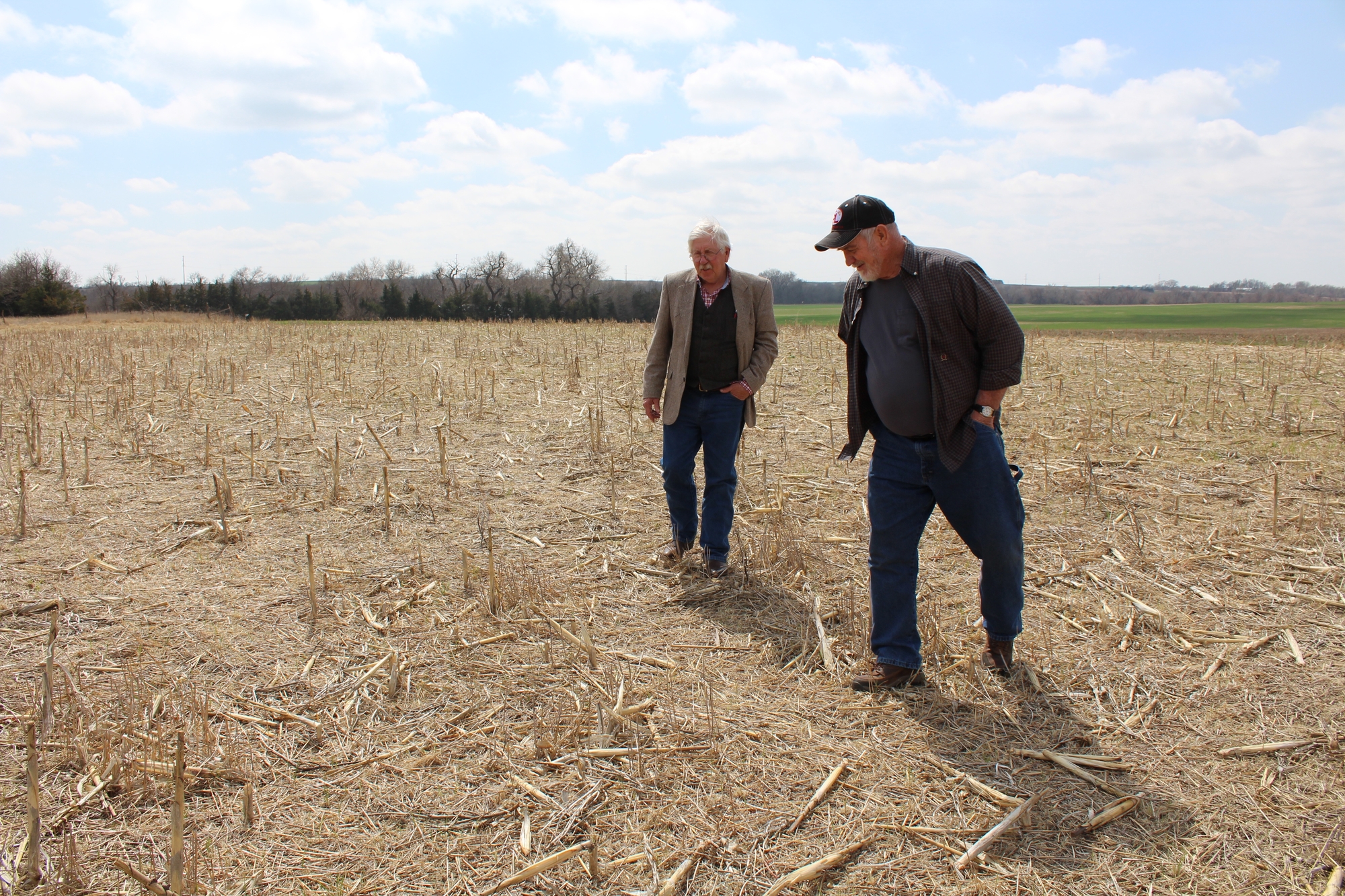
Foto principal: Jim French, Center senior policy advisor, (left) checks out Gene Albers’ (right) field of cover crops near Cunningham, Kansas, in March. One of the Center’s farm bill priorities is to eliminate crop insurance rules that treat planting cover crops differently than other farming practices. | Photo by Rhea Landholm
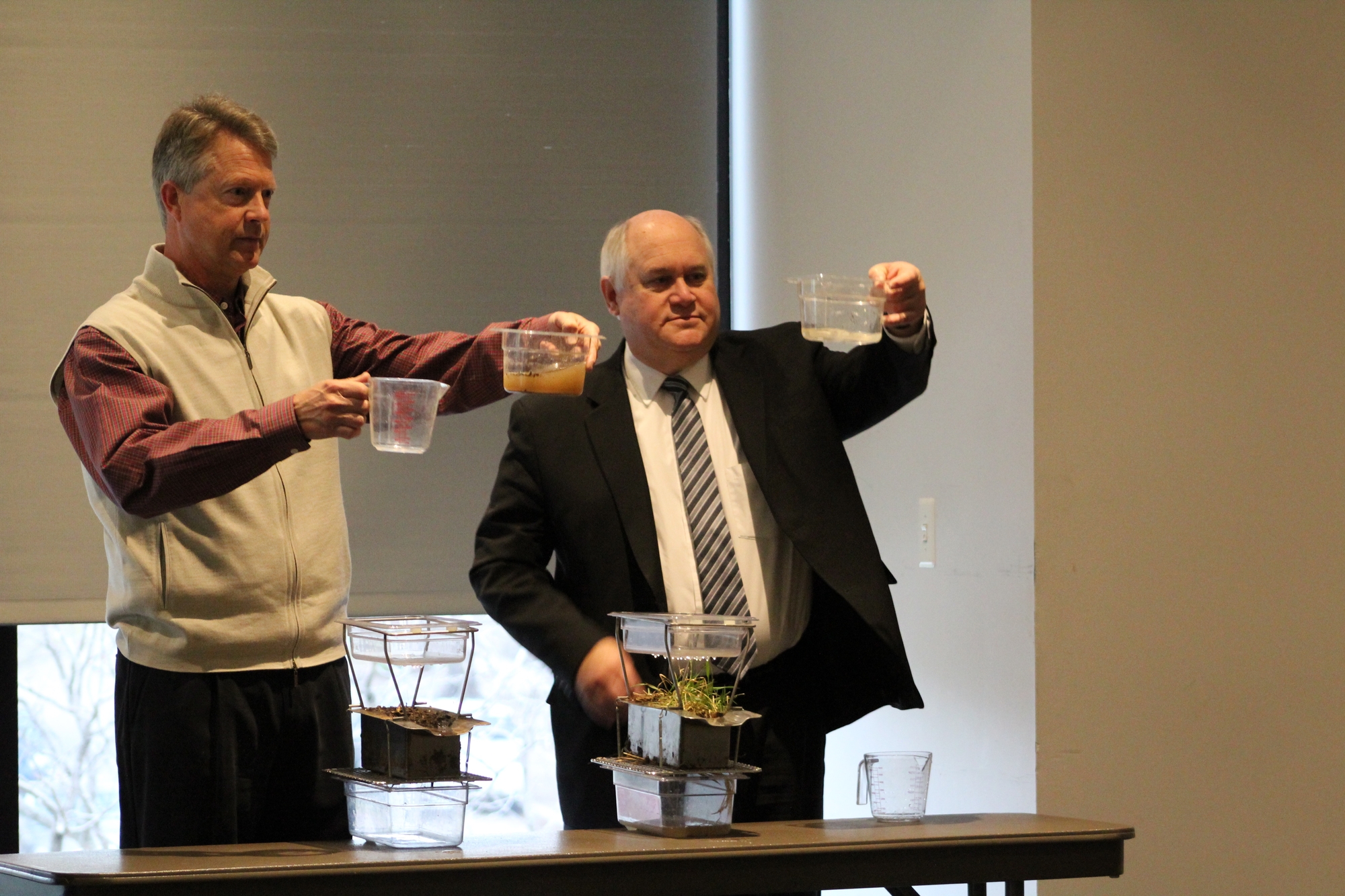
Foto insertada: U.S. Reps. Roger Marshall and Ron Estes complete a simulation on the effects of heavy rainfall on bare soil (Marshall) as opposed to soil under cover crops (Estes), or continuous vegetation, at an event on March 28 in Wichita. Attendees heard about success of conservation in the Cheney Lake Watershed from two farmers who participate in working lands conservation programs, Center for Rural Affairs, Cheney Lake Watershed Inc., City of Wichita, Kansas Natural Resource Conservation Service, Kansas Association of Conservation Districts, and the Environmental Protection Agency. | Photo by Rhea Landholm