
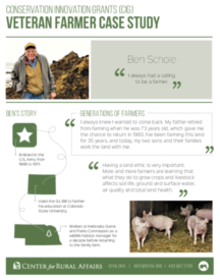
Enlisted in the U.S. Army from 1968 to 1971, Ben used the G.I. Bill to further his education at Colorado State University. Later, he worked at Nebraska Game and Parks Commission as a wildlife habitat manager for a decade.
Then, the time was right for Ben to return home to the family farm, and pick up where his father left off. Now, he runs the operation as closely as possible to the way his father did—the farm is a diversified operation, which is practical for a small family farm.
Conservation and fair treatment of the land is of the utmost importance to Ben, so he utilizes different programs such as the Conservation Reserve Program (CRP), Wetlands CRP, and the Conservation Stewardship Program (CSP). The re-establishment of wind breaks, composting of hog’s bedding, and doing split-application of fertilizers, as well as using cover crops like turnips, radishes, and oats, ensures that the land stays at its best.
Este estudio de caso fue financiado por la Beca de Innovación en Conservación del Servicio de Conservación de Recursos Naturales del Departamento de Agricultura de los Estados Unidos (USDA). El trabajo del Centro, gracias a esta beca, destaca a productores principiantes, mujeres y veteranos que utilizan prácticas de conservación en sus explotaciones agrícolas. Manténgase al tanto para obtener información sobre los próximos seminarios web dirigidos a agricultores y ganaderos principiantes, mujeres y veteranos.
Check out our feature blog on Ben, by aquí.
Este material se basa en un trabajo financiado por el Servicio de Conservación de Recursos Naturales del USDA, bajo el número 69-3A75-17-46. Las opiniones, hallazgos, conclusiones o recomendaciones expresadas en esta publicación son responsabilidad de los autores y no reflejan necesariamente las del USDA. El USDA es un proveedor y empleador que ofrece igualdad de oportunidades.
Cora Fox, Liz Daehnke, Kylie Kai, Cody Smith y Rhea Landholm contribuyeron a la elaboración de este estudio de caso.