
Nota del editor
Since its inception, the Center for Rural Affairs has chosen to advance a set of values that reflect the best of rural America. This month’s newsletter focuses on “RESPONSIBILITY placed upon each of us to contribute to our community and society.”
A lo largo de esta edición, podrá apreciar este valor en la visión del teniente coronel Anthony y Mariel Barreras y en sus interacciones con los agricultores veteranos que se inician en la actividad; en las empresas de Dakota del Sur que nos informan de sus fortalezas y áreas que necesitan atención; y en Laurie Donnell, quien comienza su nuevo rol ayudando a los emprendedores rurales.
We have a responsibility to tell our lawmakers to limit loopholes in farm program payments and to support beginning and underserved farmers with Farm Service Agency loans. In addition, as community members and local officials, we are tasked with addressing concerns from new development, such as wind energy.
Responsibility is also found in our executive director’s essay as he tells us about the Center’s roots and growing impact.
Para más información, visite cfra.org.
En esta edición
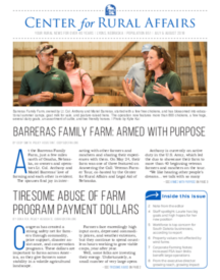
Barreras family farm: Armed with purpose – At the Barreras Family Farm, just a few miles north of Omaha, Nebraska, co-owners and operators Lt. Col. Anthony and Mariel Barreras’ love of farming and each other is evident.
Tiresome abuse of farm program payment dollars – Congress has created a strong safety net for farmers through commodity, price support, disaster assistance, and conservation programs. These dollars are important to farms across America, as they give farmers some stability in a volatile agricultural landscape.
From the desk of the executive director: Growing reach, growing impact – The Center for Rural Affairs makes its home office in Lyons, Nebraska. We built a new office in this northeast Nebraska community of 851 people in 2004.
Según un informe, la fuerza laboral es la principal preocupación de las empresas de Dakota del Sur. – The top need for small businesses in South Dakota is finding quality employees, according to a report
recently released by the Center for Rural Affairs and South Dakota State University. Owners also identified employee quantity issues as the leading growth inhibitor.
Property values not affected by wind farms – When it comes to economic development tools, wind energy has paid off for rural areas. Whether it be new employment opportunities, additional revenue for counties, or direct payments to landowners, wind energy has brought significant benefits to rural communities.
Corporate farming notes: increased FSA loan limits benefit large operations – Even though farming has become increasingly expensive, from land value to input costs, some farm groups have demanded an increase in Farm Service Agency (FSA) loan limits. Recent farm bill proposals from Congress responded to those demands.
Regístrese para recibir el boletín informativo gratuito aquí.