
Resumen
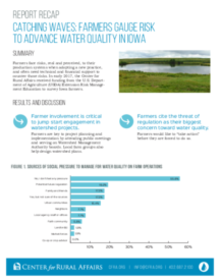
Los agricultores se enfrentan a riesgos, reales y percibidos, para sus sistemas de producción al adoptar nuevas prácticas, y a menudo necesitan apoyo técnico y financiero para contrarrestarlos. A principios de 2017, el Centro de Asuntos Rurales recibió financiación del Departamento de Agricultura de los Estados Unidos (USDA) a través de su programa de Educación en Gestión de Riesgos para realizar una encuesta entre los agricultores de Iowa.
Resultados y discusión
• Farmer involvement is critical to jump start engagement in watershed projects. Farmers are key to project planning and implementation by attending public meetings and serving on Watershed Management Authority boards. Local farm groups also help design watershed plans.
• Farmers cite the threat of regulation as their biggest concern toward water quality. Farmers would like to “take action” before they are forced to do so.
• Weather, including more floods and droughts, is seen as the biggest risk to a farm operation. Protecting soil health is known to be a way to protect against these risks while preventing erosion and improving water quality.
• Trust is key. Building relationships between watershed coordinators, landowners, farmers, and watershed board members takes time.
View the entire report: “Catching Waves: Farmers Gauge Risk to Advance Water Quality in Iowa,” a report published in 2018 by Katie Rock and the Center for Rural Affairs, can be found at cfra.org/publications/CatchingWaves.