
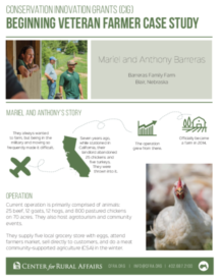
- They always wanted to farm, but being in the military and moving so frequently made it difficult.
- Seven years ago, while stationed in California, their landlord abandoned 25 chickens and five turkeys. They were thrown into it.
- The operation grew from there.
- Officially became a farm in 2014.
Operación
Current operation is primarily comprised of animals: 25 beef, 12 goats, 12 hogs, and 800 pastured chickens on 70 acres. They also host agrotourism and community events.
They supply five local grocery store with eggs, attend farmers market, sell directly to customers, and do a meat community-supported agriculture (CSA) in the winter.
Prácticas de conservación
"We only get one piece of land. We talk to our children about conservation, and have been doing so since the kids were less than two years old. Our operation has planted pasture, pollinator mix, and cover crops in areas that have faced erosion with recent flooding." -Mariel Barreras
Consejos para agricultores principiantes
"Follow your dreams. Anyone can farm, you just have to work hard and look for answers. The farmers who continue after five years are the ones with passion and who look for answers. Also, get connected with resources in the area that can support you, help you learn, and connect you to more resources and programs." -Mariel Barreras
Advice to beginning veteran farmers
"Start before you retire [from the military]. If you aren’t coming from an agriculture background, you have to learn as you go. And, that can be costly. It helps having the financial security so that when you fail, you’re not in over your head." -Mariel Barreras
Otras oportunidades
“Internships are positive opportunities, where a service member could intern for a farmer. The farmer would get help with labor, and the service member would get experience; learning what they like and eventually getting to a place where they could develop a plan for themselves.” -Mariel Barreras
Este material se basa en el trabajo respaldado por el Servicio de Conservación de Recursos Naturales del Departamento de Agricultura de los Estados Unidos, con el número 69-3A75-17-46. Las opiniones, hallazgos, conclusiones o recomendaciones expresadas en esta publicación son las del autor o autores y no necesariamente reflejan las opiniones del USDA. El USDA es un proveedor y empleador que ofrece igualdad de oportunidades.